




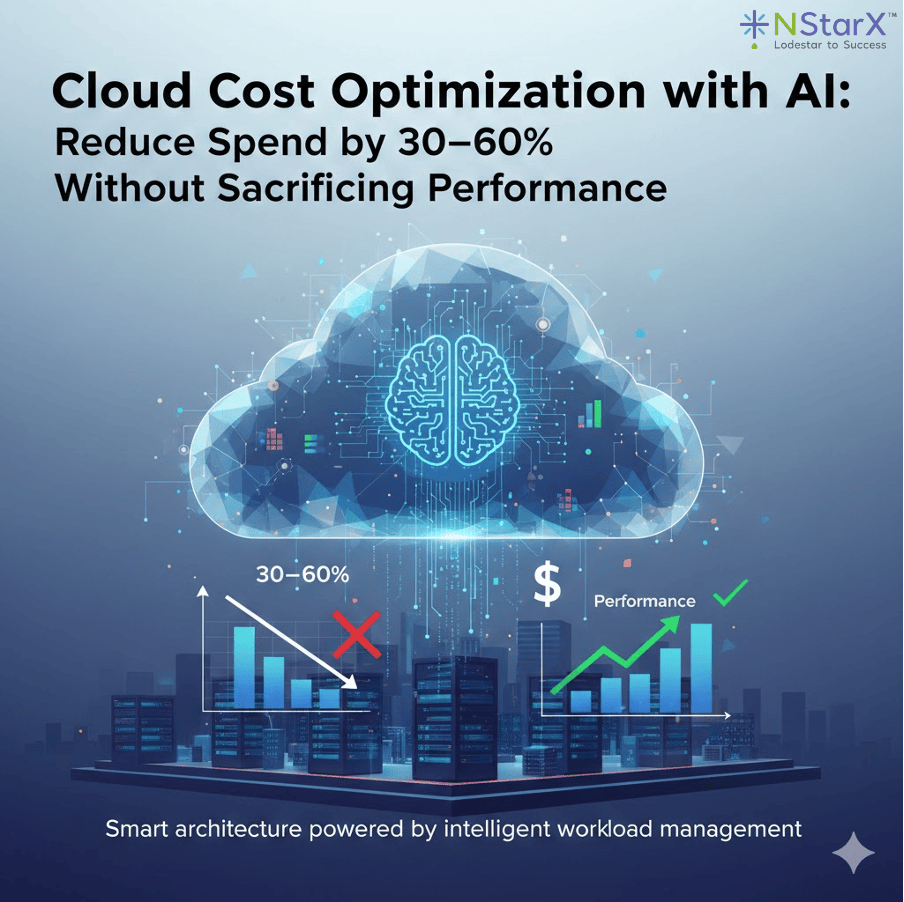
Smart architecture powered by intelligent workload management
The Cloud Cost Crisis Enterprises Face in 2025
Cloud computing has become the backbone of modern enterprise operations, but the financial burden is reaching unprecedented levels. Average monthly AI budgets are projected to rise by 36% in 2025, reflecting the shift toward larger and more complex AI initiatives [1], while global cloud spending is forecast to surpass $723.4 billion in 2025, representing 21.5% growth from 2024 [6]. The harsh reality? Organizations are hemorrhaging money through inefficiency.
Nearly half of IT leaders estimate that over 25% of their cloud spend is wasted, with about one in three saying over half of cloud costs go to waste [2]. This isn’t merely a financial inconvenience—it’s a strategic crisis that demands immediate executive attention. An estimated 21% of enterprise cloud infrastructure spend, equivalent to $44.5 billion in 2025, is wasted on underutilized resources [3].
For CFOs and CTOs navigating budget constraints while accelerating digital transformation, the question isn’t whether to optimize cloud costs—it’s how to do it intelligently without compromising performance, innovation, or competitive advantage.
Why Traditional Cost Management Approaches Are Failing
The complexity of modern cloud environments has rendered manual cost management obsolete. Organizations struggle with several fundamental challenges that traditional approaches cannot solve:
Limited Visibility Across Multi-Cloud Environments: Most organizations lack comprehensive visibility into their cloud spending spanning multiple providers and accounts [7]. Without real-time insights into resource consumption patterns, teams operate blindly, unable to identify waste or optimize effectively.
Decentralized Decision-Making Without Accountability: Development teams provision resources instantly, often without understanding cost implications. What begins as a temporary testing environment becomes permanent infrastructure that nobody remembers to decommission. This organizational behavior, multiplied across hundreds of teams, creates massive waste.
Complex Pricing Models: Cloud providers offer numerous pricing options, instance types, and discount programs that even experienced architects struggle to navigate effectively [3]. Organizations implementing effective cloud cost optimization strategies can reduce waste by 20–30% while freeing up capital for innovation [4].
The Speed Trap: Cloud adoption enables rapid deployment but often bypasses the governance and cost controls that existed in traditional IT procurement. Speed without structure equals spiraling costs.
The AI-Powered Solution: Intelligent Cloud Cost Optimization
Artificial intelligence is transforming cloud cost management from reactive firefighting to proactive strategic optimization. AI-driven platforms analyze usage patterns, predict demand, and automate decision-making to eliminate waste without human intervention [5].
How AI Delivers 30-60% Cost Savings
Intelligent Rightsizing and Resource Optimization: AI tools analyze resource usage including CPU, memory, and I/O over time to recommend optimal instance types or sizes [3]. Instead of manually reviewing thousands of instances, AI continuously monitors utilization and automatically adjusts resources to match actual needs.
Organizations can achieve up to 40% savings through AI-driven rightsizing and resource optimization [5]. Real-world implementations demonstrate dramatic results: EC2 instances benefit from addressing over-provisioned resources, achieving savings of up to 66% through proper sizing initiatives, while S3 storage optimization delivers up to 55% cost reductions [3].
Predictive Analytics for Demand Forecasting: AI leverages historical usage patterns to forecast future resource demands with remarkable accuracy. By 2026, 60% of organizations will leverage specialized cloud computing services to optimize scaling, deployment, and cost of their AI-enabled applications [4]. This predictive capability enables organizations to proactively scale resources up or down, avoiding both over-provisioning and performance degradation.
Automated Workload Scheduling: AI identifies non-production environments and implements automated scheduling for start/stop operations. Automated scheduling for non-production environments delivers 70% cost reduction by ensuring resources only run when needed [3].
Spot Instance Optimization: Enhanced Spot Instance integration provides up to 90% discounts compared to on-demand pricing [3]. AI-powered spot instance management uses machine learning to predict interruptions and seamlessly migrate workloads, capturing maximum savings while maintaining reliability.
Anomaly Detection and Cost Governance: AI continuously monitors spending patterns and detects anomalies in real-time [5]. When costs spike unexpectedly, automated alerts notify relevant engineering teams with actionable insights, enabling rapid response before small issues become budget disasters.
The FinOps Revolution: AI Meets Financial Operations
The emergence of FinOps represents a fundamental shift in how enterprises approach cloud financial management. 89% of industry stakeholders identify FinOps as the key to reigning in cloud cost complexity, and 59% of organizations now have FinOps teams, up from 51% the previous year, indicating rapid adoption of structured cost management practices [17].
FinOps combines financial accountability with engineering agility, creating a culture where cost optimization becomes everyone’s responsibility. Organizations implementing FinOps practices report an average 30% reduction in cloud costs [11].
The Four-Phase FinOps Framework Powered by AI
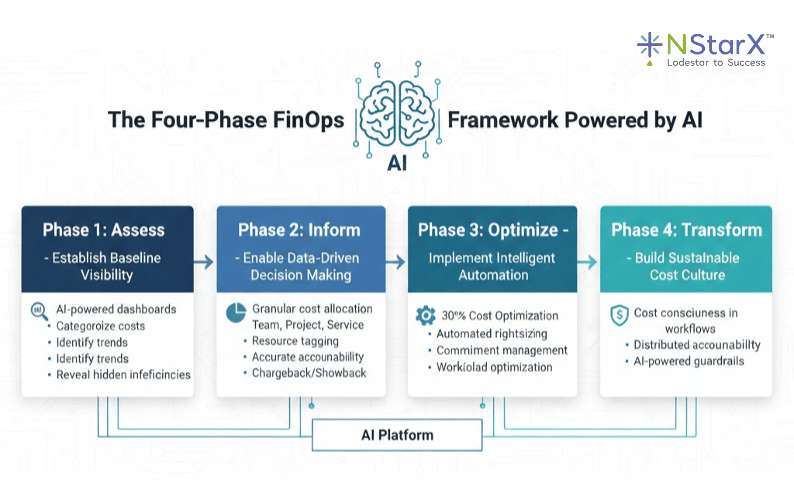
Phase 1: Assess – Establish Baseline Visibility: Organizations begin by conducting comprehensive analysis of current and historical spending patterns using AI-powered dashboards that automatically categorize costs, identify trends, and reveal hidden inefficiencies [16].
Phase 2: Inform – Enable Data-Driven Decision Making: AI platforms provide granular cost allocation by team, project, service, and business unit. Resource tagging aligned with FinOps dimensions enables accurate accountability and chargeback/showback mechanisms [11].
Phase 3: Optimize – Implement Intelligent Automation: Organizations implementing systematic FinOps practices consistently achieve 30% or greater cost optimizations across major cloud services, often within just six weeks of implementation [16]. This phase focuses on automated rightsizing, commitment management, and workload optimization.
Phase 4: Transform – Build Sustainable Cost Culture: The final phase integrates cost consciousness into development workflows, shifting from centralized cost management to distributed accountability supported by AI-powered guardrails [18].
Enterprise Implementation Strategy: A Roadmap for CFOs and CTOs

Step 1: Gain Complete Cost Visibility
Implement AI-powered cost management platforms that provide real-time visibility across all cloud providers, services, and accounts. The FinOps market is valued at $5.5 billion in 2025, growing at a CAGR of 34.8%, with numerous mature solutions available [12].
Key capabilities to prioritize:
- Unified dashboards consolidating AWS, Azure, and Google Cloud spending
- Granular cost allocation and tagging automation
- Custom unit cost metrics aligned with business outcomes
- Real-time anomaly detection and alerting
Step 2: Establish Governance and Accountability
50% of respondents state workload optimization and waste reduction as their top FinOps priority [15]. Create cross-functional FinOps teams bringing together finance, engineering, and operations. Define clear roles, responsibilities, and KPIs that align cloud spending with business value.
Step 3: Deploy AI-Powered Optimization
Implement automated optimization engines that continuously analyze and adjust resources. AI-driven cost optimization has evolved from basic monitoring to predictive analytics and automated actions [5]. Focus on high-impact areas:
Compute Optimization: Leverage AI for intelligent instance selection, automated rightsizing, and spot instance management with ML-based interruption handling.
Storage Optimization: Implement intelligent storage tiering and lifecycle policies that automatically move data to the most cost-effective storage class.
Network Optimization: Analyze data transfer patterns and optimize routing to minimize egress costs.
Step 4: Scale with Commitment Management
Organizations typically implement centralized, decentralized, federated, or center of excellence models for FinOps [17]. Use AI to optimize reserved instance and savings plan portfolios, automatically adjusting commitments based on usage forecasts to maximize discounts while minimizing risk.
Step 5: Measure and Iterate
Establish business-aligned cost metrics that connect spending to outcomes. Track key indicators such as cost per transaction, cost per user, and cost per revenue dollar. High-performing organizations focus on cost efficiency—the ratio of business value delivered to cloud spending—rather than absolute spending [18].
Managing AI Workload Costs: The New Frontier
As AI and machine learning workloads proliferate, they introduce new cost management challenges. 63% of organizations are now tracking AI spend, up from 31% last year, representing a fundamental shift in cloud cost management [17].
Cloud-based AI tools comprise nearly two-thirds of AI budgets, making cloud cost optimization crucial to prevent overspending [1]. GPU instances, essential for AI workloads, represent significant expenses. Estimates suggest AI in cloud computing has driven costs up by 30% [10].
AI-powered FinOps platforms enable organizations to:
- Allocate AI costs to specific projects, teams, and models
- Track cost per inference, cost per training run, and other AI-specific metrics
- Optimize GPU utilization through intelligent scheduling and spot instance management
- Predict AI infrastructure costs based on model complexity and usage patterns
Real-World Results: Enterprise Success Stories
The theoretical promise of AI-powered cloud cost optimization translates into tangible business impact:
Advertising firm WPP saved $2 million after just three months of FinOps deployment, eventually scaling to a 30% annual cost reduction on yearly cloud spend [16]. They leveraged automated sizing recommendations and comprehensive governance.
One enterprise AI learning platform achieved 99.99% uptime while cutting cloud costs approximately 60% through comprehensive optimization strategies including intelligent resource allocation and automated scaling [5].
CloudTrail services see dramatic cost reductions of up to 94% through elimination of unused features and environments, demonstrating the power of AI-driven waste identification [3].
Overcoming Implementation Challenges
While the benefits are compelling, organizations must navigate several challenges:
Skills Gap: 60% of organizations experience a shortage of cloud computing talent in 2025 [6]. Partner with experienced FinOps providers or invest in upskilling internal teams through certifications like FinOps Practitioner.
Tool Complexity: FinOps tools can bear considerable cost, around 3% to 5% of the cloud bill at the high end [13]. Carefully evaluate ROI and start with platforms offering free tiers or usage-based pricing.
Organizational Resistance: Moving from reactive cost-cutting to proactive optimization requires cultural transformation. Build executive sponsorship, celebrate quick wins, and demonstrate business value through concrete metrics.
Multi-Cloud Complexity: 78% of organizations prefer multi-cloud and hybrid cloud environments to avoid vendor lock-in [6]. Implement unified FinOps platforms that provide consistent visibility and governance across all providers.
The Future of Cloud Cost Management: Trends to Watch
As we progress through 2025 and beyond, several trends will reshape cloud cost optimization:
AI for FinOps: Organizations will increasingly leverage AI not just to optimize costs but to predict future spending patterns, automatically negotiate with cloud providers, and optimize architecture decisions at development time [18].
Sustainable FinOps: Green cloud solutions and choosing providers with energy-efficient data centers will become a key cost-saving factor [13]. Carbon-aware computing will align financial and environmental goals.
FinOps Beyond Cloud: 65% of FinOps practices are being asked to optimize spend for SaaS, licensing (49%), private cloud (39%), data centers (36%), and AI (63%) [17]. The discipline is expanding to encompass total technology spend.
Edge Computing Integration: 78% of respondents anticipate their organizations will boost use of edge technology in the next 12 months as AI chips and smart devices become more advanced, creating new optimization opportunities [6].
Take Action: Your Cloud Cost Optimization Checklist
For CTOs, CFOs, and cloud governors ready to implement AI-powered cost optimization:
Immediate Actions (Week 1-2):
- Audit current cloud spending across all providers
- Identify top 10 cost centers and their business justification
- Evaluate AI-powered FinOps platforms (CloudZero, Apptio, Holori, CloudHealth) [14]
- Establish executive sponsorship for FinOps initiative
Short-Term Initiatives (Month 1-3):
- Deploy cost visibility and monitoring tools
- Implement resource tagging standards
- Create cross-functional FinOps team
- Execute quick-win optimizations (unused resources, non-production scheduling)
- Set up anomaly detection and alerting
Long-Term Transformation (Quarter 2-4):
- Deploy AI-powered automated optimization
- Implement commitment management strategy
- Develop cost allocation and chargeback mechanisms
- Build cost culture through training and incentives
- Establish continuous improvement processes
Conclusion: The Imperative of Intelligent Cloud Cost Management
Cloud spending will continue accelerating as enterprises deepen their digital transformation and AI adoption. The organizations that thrive will be those that master the art and science of intelligent cost optimization—harnessing AI to eliminate waste, maximize efficiency, and align spending with business value.
The opportunity is clear: Organizations implementing systematic FinOps practices consistently achieve 30% or greater cost optimizations, with many reaching 60% savings through comprehensive AI-powered approaches [16]. These aren’t marginal improvements—they represent millions of dollars redirected from waste to innovation.
For CFOs seeking to control spiraling cloud costs while funding strategic initiatives, and for CTOs balancing innovation velocity with fiscal responsibility, AI-powered cloud cost optimization isn’t optional—it’s imperative. The question isn’t whether to act, but how quickly you can implement intelligent cost management before your competitors do.
The future belongs to organizations that combine cloud agility with financial discipline, powered by artificial intelligence that works tirelessly to optimize every dollar spent. Your cloud cost optimization journey begins today.
References
- CloudZero. (2025). The State Of AI Costs In 2025. https://www.cloudzero.com/state-of-ai-costs/
- US Cloud. (2025). 2025 Guide to Cloud Cost Optimization for Modern Enterprises. https://www.uscloud.com/blog/cloud-cost-optimization-2025-guide/
- Scalr. (2025). Cloud Cost Optimization Best Practices for 2025: A Comprehensive Guide. https://scalr.com/learning-center/cloud-cost-optimization-best-practices-for-2025-a-comprehensive-guide/
- Deloitte. (2025). As cloud costs rise, hybrid solutions are redefining the path to scaling AI. https://www.deloitte.com/us/en/insights/topics/emerging-technologies/ai-infrastructure-hybrid-cloud-cost-optimization.html
- CloudChipr. (2025). AI-Powered Cloud Cost Optimization: Strategies, Tools, and Real-World Insights. https://cloudchipr.com/blog/ai-cost-optimization
- Pelanor. (2024). 60 Cloud Computing Statistics: Market Snapshot. https://www.pelanor.io/learning-center/learn-cloud-computing-statistics
- Ivoyant. (2025). Cloud Cost Optimization in 2025: Global IT Budget Insights and Practical AI Integration. https://www.ivoyant.com/blogs/cloud-cost-optimization-in-2025-global-it-budget-insights-and-practical-ai-integration
- CloudZero. (2025). AI Costs Climb 36% But ROI Still Unclear, Report Finds. https://www.cloudzero.com/press-releases/20250522/
- OpenPR. (2025). Automated Cloud Cost Optimization Platform Global Market Research Report 2025-2031. https://www.openpr.com/news/4292960/automated-cloud-cost-optimization-platform-global-market
- CloudZero. (2025). AI Costs In 2025: A Guide To Pricing, Implementation, And Mistakes To Avoid. https://www.cloudzero.com/blog/ai-costs/
- Vertex CS. (2025). FinOps Strategies For Cloud Cost Optimization In 2025. https://vertexcs.com/achieving-cloud-financial-operations-finops-excellence-strategies-for-enterprise-cost-control-and-optimization/
- Economize. (2023). State of Cloud Cost and FinOps Market: 2023 Report. https://www.economize.cloud/cloud-cost-finops-market-report
- Deloitte. (2025). Cloud gets lean: ‘FinOps’ makes every dollar work harder. https://www.deloitte.com/us/en/insights/industry/technology/technology-media-and-telecom-predictions/2025/tmt-predictions-finops-tools-help-lower-cloud-spending.html
- Holori. (2025). Best 20 FinOps and Cloud Cost Management tools in 2025. https://holori.com/20-best-finops-and-cloud-cost-management-tools-in-2025/
- Softjourn. (2025). The State of FinOps 2025: FinOps Stats. https://softjourn.com/insights/finops-stats
- Ambush. (2025). Stop Cloud Waste: A Four-Phase FinOps Guide. https://www.getambush.com/article/cut-cloud-waste-30-savings-in-6-weeks/
- CloudZero. (2025). The State Of FinOps 2025: Cloud+, AI Visibility, And Other Key Takeaways. https://www.cloudzero.com/blog/state-of-finops-2025/
- nOps. (2025). 8 FinOps Best Practices for 2025. https://www.nops.io/blog/top-finops-practices-to-effectively-manage-cloud-costs/
- ProsperOps. (2025). Our Take on the 2025 State of FinOps Report. https://www.prosperops.com/blog/2025-state-of-finops-report/
- CIO. (2025). FinOps breaks out of the cloud. https://www.cio.com/article/3839075/finops-breaks-out-of-the-cloud.html