




A practical guide for CIOs, CDOs, Enterprise Architects, and Data Platform Leaders navigating modern data strategy.
Foreword
Most enterprises do not have a data problem. They have an ownership problem dressed up as a data problem.
Data warehouses and centralized lakes were the right answer for a different era — when data volumes were smaller, analytics teams were few, and the pace of business change was slower. That era is over for most large organizations. The patterns that served us well for twenty years are now the reason data projects take months, pipelines break silently, and analytics teams spend the majority of their time doing data archaeology rather than creating value.
Data Mesh is not a product you buy, a platform you deploy, or a technology stack you adopt. It is an organizational design pattern with technical implications. Organizations that treat it as a pure technology project will fail. Organizations that treat it as a pure organizational change will also fail — because good intentions without engineering discipline produce the same data swamps they were trying to escape.
This guide is written for practitioners and the leaders who sponsor them. It is deliberately skeptical. Where evidence exists, we cite it. Where it is opinion or extrapolation, we say so. Our goal is not to sell Data Mesh but to help you determine honestly whether it is the right answer for your organization — and if so, how to approach it without repeating the most common mistakes.
“The goal of a data platform is not to store data. It is to accelerate the speed at which teams can use data to make better decisions.”
Who This Is Written For
The Primary Readers
This document is written for a specific set of senior practitioners. The challenges it addresses are real for large, complex organizations — it will be less relevant for startups or companies with fewer than a few hundred employees and a single engineering team.
Chief Information Officer (CIO)
The CIO is accountable for technology investment decisions and must balance innovation against operational stability. Their concern with data architecture is predominantly about risk: data governance failures, regulatory exposure, and the cost of rework when platforms fail to scale. They need to understand whether Data Mesh reduces or increases organizational complexity, and what the three-to-five year cost trajectory looks like compared with continuing on the current path.
Chief Data Officer (CDO)
The CDO owns the data strategy and is typically closer to the problem than the CIO. They experience the pain of centralized data teams directly: the backlog of data product requests that takes months to clear, the quality issues that appear only after a report has been shared with the board, the endless debates about who owns which dataset. They are the most natural sponsor for Data Mesh but also the most likely to underestimate the organizational change required.
Enterprise Architect & Data Platform Lead
These are the practitioners who will design and build the platform if the organization moves forward. They need precision — not marketing language. They will rightly ask about domain boundary definition, data contract enforcement, API versioning, observability, and how federated governance interacts with existing cloud data platforms. This document gives them a framework; the implementation details require additional depth.
VP Engineering & Product Leaders
Engineering and product leaders who own domains are the people Data Mesh asks to do more work. They gain autonomy and direct control over their data assets, but they also gain accountability. The honest question for these leaders is whether their teams have the bandwidth and skills to take on data product ownership alongside feature delivery.
Common Objections by Role
| Role | Primary Concern | Common Objection |
|---|---|---|
| CIO | Cost & governance risk | “We just invested in our data lake.” |
| CDO | Change management | “Our domains aren’t ready to own their data.” |
| Enterprise Architect | Platform complexity | “We’ll end up with incompatible schemas.” |
| VP Engineering | Team bandwidth | “My teams are already fully committed.” |
| Data Governance Lead | Compliance | “How do we maintain control with federated governance?” |
Where the Industry Stands
Adoption Trends
Data Mesh as a term was introduced by Zhamak Dehghani at ThoughtWorks in 2019. The concept gained significant enterprise attention between 2021 and 2023 as large organizations reached the scaling limits of centralized data platforms. By 2024, adoption had moved from early-adopter experimentation into mainstream evaluation, though full implementations remain the minority.
Gartner’s 2023 Magic Quadrant for Data Integration Tools noted a distinct shift toward decentralized data architectures among large enterprises. McKinsey & Company research from 2022 suggested that organizations with mature data product practices — a prerequisite for Data Mesh — demonstrate measurably faster analytics delivery cycles. Neither finding is specific to Data Mesh as a label, but both reflect the underlying principles.
Analyst note: Treat any quantitative adoption figures you encounter with caution. Most surveys conflate “evaluating” with “implementing” and “implementing” with “fully operationalized.” The number of organizations with mature Data Mesh implementations as of 2024 is likely in the hundreds globally, not thousands.
Industries with Strongest Adoption
- Financial services — regulatory pressure for data lineage and ownership aligns naturally with domain-based governance
- Healthcare — HIPAA requirements and the need for domain-specific data stewardship
- Retail & e-commerce — multiple product domains with distinct data needs and high velocity of change
- Technology companies — engineering culture and existing platform maturity lower the barrier to entry
- Telecommunications — complex multi-domain operations (network, billing, customer) with historically siloed data
Research Summary
| Source | Key Claim | Evidence Strength | Date |
|---|---|---|---|
| ThoughtWorks / Z. Dehghani | Domain ownership and data-as-product reduce delivery bottlenecks | Conceptual + case studies | 2019–2022 |
| Gartner | Decentralized architectures gaining enterprise traction | Survey-based | 2023 |
| McKinsey Global Institute | Mature data product practices correlate with faster delivery | Survey + case studies | 2022 |
| AWS re:Invent case studies | Domain-owned data reduced mean time to insight at several enterprises | Self-reported | 2022–2023 |
| Data Mesh Learning Community | Implementation challenges cluster around governance and skills, not technology | Practitioner survey | 2023 |
Why Traditional Data Architectures Struggle at Scale
Before evaluating Data Mesh, it is worth being precise about the problems it is attempting to solve. Many of these problems are real. Some are overstated. And some architectures that are positioned as the problem are still the right choice in certain contexts.
Centralized Data Lakes
The promise of the data lake — ingest everything, schema-on-read, one source of truth — has delivered value at many organizations. The challenge is what happens over time. As data volumes grow and the number of consumers increases, the lake becomes ungovernable. Data pipelines multiply. Schemas are inconsistently documented or not documented at all. The team responsible for the lake becomes a bottleneck: every new dataset, every schema change, every new consumer requires their involvement.
The result, documented extensively in the industry, is what practitioners call a data swamp: a repository where data exists but cannot be trusted, discovered, or used reliably. A 2019 Gartner report estimated that 60% of data lake projects fail to reach production. The technical causes vary, but the organizational cause is consistent — a single team cannot maintain quality for the data of an entire enterprise.
Enterprise Data Warehouses
The data warehouse predates the data lake and remains a powerful tool for specific use cases: structured, high-value reporting, regulatory submissions, executive dashboards with known schemas and stable query patterns. Where warehouses struggle is adaptability. Schema changes in a normalized warehouse are expensive. Adding a new data source requires ETL work that often takes weeks. The warehouse works well as a curated, high-trust layer but was never designed as a general-purpose analytics platform for a large, fast-moving organization.
ETL Bottlenecks and Team Ownership Issues
Both architectures share a structural problem: the data team is the middleman between the business domain that generates data and the analysts or systems that consume it. This creates a queue. Every request — new dataset, schema change, quality fix, new consumer — enters the queue. The data team becomes a professional bottleneck, doing their best but structurally unable to serve demand at the pace of the business.
The ownership ambiguity compounds the problem. When a pipeline breaks, who is responsible? The data engineering team that built the pipeline? The source system team that changed the upstream schema without notice? The business team that defined the transformation logic years ago? In most centralized architectures, the answer is unclear — and unclear ownership produces poor incentives for data quality.
Important caveat: If your organization has a single analytics domain, a small engineering team, and stable data requirements, a well-managed data warehouse or a modest data lake is almost certainly the right answer. Data Mesh introduces coordination overhead that is only justified when centralization has become the binding constraint.
Where Centralized Architectures Still Work
- Organizations with fewer than 5–10 distinct data-generating domains
- Regulatory reporting where a single curated layer is a compliance requirement
- Organizations with small or immature analytics functions that are still building core capabilities
- Use cases where consistency and auditability outweigh delivery speed
What Is Data Mesh?
Data Mesh is an architectural and organizational pattern for managing data at scale in large, complex enterprises. It was formalized by Zhamak Dehghani and rests on four principles. Understanding these principles — not just the labels — is essential before evaluating whether the pattern applies to your organization.
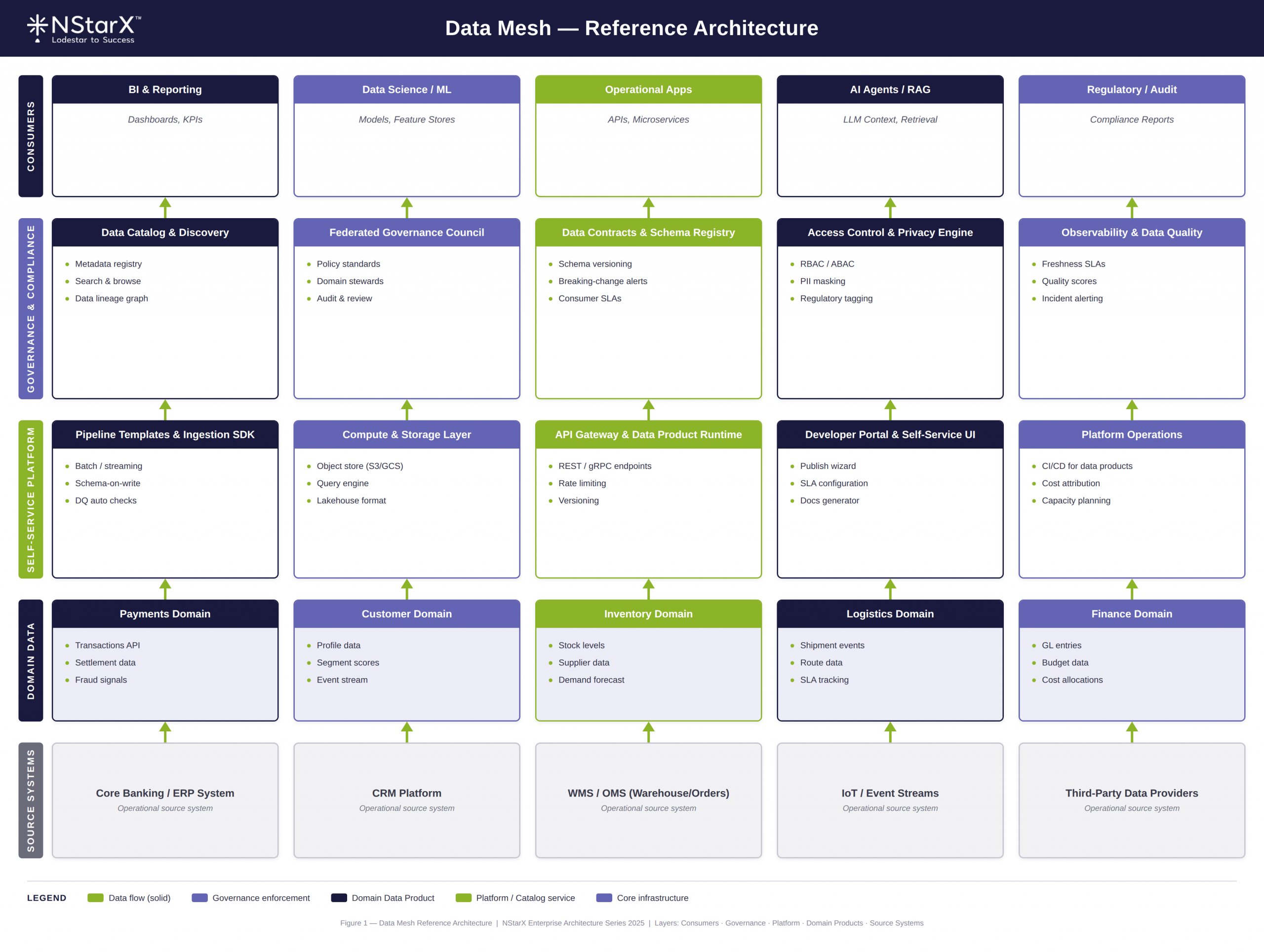
Figure 1 (see Section 05) illustrates how the four principles map to concrete architectural layers in a typical enterprise implementation.
Principle 1: Domain Ownership
In a Data Mesh, the team that generates data is also accountable for making it available as a reliable, well-documented product. The payments domain owns payments data. The inventory domain owns inventory data. This is a direct inversion of the centralized model, where a separate data engineering team ingests and manages data from across the organization.
The analogy that resonates with executives: think of how product teams work in modern software organizations. A product team owns a service end-to-end — design, development, operations, and quality. They do not hand the code to a central operations team and walk away. Data Mesh applies that same ownership model to data.
Principle 2: Data as a Product
Ownership alone is insufficient. A domain that owns its data but serves it as an undocumented, unstable internal dump has not improved anything. “Data as a Product” means treating data outputs with the same discipline applied to customer-facing products: clear interfaces (schemas and APIs), defined service levels, documentation, discoverability, and a commitment to backward compatibility.
A data product should pass what Dehghani calls the FAIR test — Findable, Accessible, Interoperable, and Reusable. A consumer should be able to discover data products through a catalog, understand what they contain, access them through a stable interface, and integrate them without requiring direct negotiation with the producing team.
“Treating data as a product does not mean monetizing it. It means applying product discipline — defined users, clear interfaces, quality commitments, and feedback loops — to how data is published and maintained.”
Principle 3: Self-Service Data Platform
Domain teams cannot realistically build every piece of data infrastructure from scratch. A self-service platform provides the shared capabilities — data pipeline tooling, catalog infrastructure, compute resources, data contract enforcement, observability — that domain teams consume without building themselves. This platform is the enabler that makes it feasible for domain teams to own their data without requiring a full data engineering team in every business unit.
The platform team’s job is to reduce the cognitive load on domain teams. If publishing a data product requires domain engineers to understand Kafka internals, write custom Terraform, and configure their own observability stack, the platform has failed its users.
Principle 4: Federated Computational Governance
Governance in a Data Mesh is not centralized control — but neither is it the absence of standards. A federated governance model means that a cross-domain governance council sets policies (data classification standards, privacy requirements, schema conventions, SLA expectations) while domain teams are responsible for implementing those policies within their products.
The “computational” part is important: wherever possible, governance should be enforced by the platform through automated checks — schema validation, lineage tracking, access control policies, data quality tests — rather than through manual review and trust. Rules that are not enforced automatically are, in practice, suggestions.
| Principle | What It Means | What It Requires |
|---|---|---|
| Domain Ownership | Data producers own data quality and availability | Engineering accountability, domain boundary clarity |
| Data as a Product | Data treated with product discipline: interfaces, SLAs, discoverability | Data product thinking, catalog infrastructure |
| Self-Service Platform | Shared tooling reduces burden on domain teams | Platform engineering investment, developer experience focus |
| Federated Governance | Standards set centrally, implemented domain-by-domain | Policy automation, governance council, trust |
Reference Architecture
The diagram below translates the four Data Mesh principles into a concrete, five-layer architecture. It is intended as a reference starting point, not a prescriptive blueprint — every organization will adapt layer boundaries, technology choices, and domain boundaries to its own context.
Figure 1 — Data Mesh Reference Architecture — IMAGE HERE
Layer 1 — Source Systems (Bottom)
Operational systems — core banking platforms, CRM, warehouse management, IoT event streams, and third-party data providers — are the origin of all data. In a Data Mesh, source systems remain unchanged; the change is in how domain teams take responsibility for ingesting and publishing their domain’s data rather than delegating that work to a central data engineering team.
Layer 2 — Domain Data Products
Each business domain (Payments, Customer, Inventory, Logistics, Finance) owns and publishes its data as a set of versioned, documented data products. A data product is not a raw database table — it is a deliberately designed output with a stable API, defined SLAs, clear ownership, and sufficient documentation for consumers to use it independently. Domain teams publish through the self-service platform layer below them, consuming pipeline templates and catalog tooling rather than building infrastructure from scratch.
Cross-domain joins and compositions happen at the consumer layer, not within domain products. Domains do not call each other’s APIs directly for data; they publish, and consumers subscribe or query.
Layer 3 — Self-Service Data Platform
The platform layer is the enabler that makes domain ownership tractable. It provides pipeline templates and ingestion SDKs (so domain teams can publish without writing custom Kafka or Spark infrastructure), a compute and storage substrate (object storage, query engine, lakehouse format), a data product runtime with API gateways, a developer portal for publishing and configuring products, and platform operations tooling for cost attribution and CI/CD.
The platform team’s primary metric is developer experience: how long does it take a domain engineer with no prior data platform experience to publish a new data product? That number should fall over time as the platform matures.
Layer 4 — Governance & Catalog (Cross-Cutting)
Governance is shown as its own horizontal layer because it is cross-cutting — it enforces standards across all domains and consumers simultaneously. The five governance components are the Data Catalog & Discovery service (findability), the Federated Governance Council (policy standards and domain stewardship), Data Contracts & Schema Registry (schema versioning and consumer SLAs), Access Control & Privacy Engine (RBAC/ABAC, PII masking, regulatory tagging), and Observability & Data Quality (freshness SLAs, quality scores, incident alerting).
The dashed arrows in Figure 1 between the governance layer and the layers above and below it indicate that governance is not a one-directional flow — it is an enforcement and feedback mechanism that operates continuously across the architecture.
Layer 5 — Consumers (Top)
Consumers are the reason the architecture exists. They include BI and reporting tools, data science and ML workloads, operational applications, AI agents and RAG systems, and regulatory or audit reporting. Each consumer category has different latency requirements, schema expectations, and access patterns — the data product model, with its stable APIs and documented contracts, makes it feasible to serve these diverse consumers from a shared architectural foundation without requiring custom pipelines for each.
Key Architectural Decisions
| Decision | Recommended Approach | Rationale |
|---|---|---|
| Storage format | Open table format (Iceberg, Delta, Hudi) | Interoperability across query engines; time-travel for auditability |
| Schema management | Centralized schema registry per domain product | Prevents consumer breakage; enables backward compatibility checks |
| Data product interface | REST or gRPC APIs + bulk export endpoints | Stable contract; separates consumers from storage implementation |
| Governance enforcement | Policy-as-code in CI/CD pipeline | Automated enforcement; not dependent on human review at scale |
| Observability | Platform-level data quality framework | Consistent quality metrics across all domain products |
| Access control | Attribute-based (ABAC) with audit logging | Fine-grained control; supports regulatory audit requirements |
Architecture note: The reference diagram uses a technology-neutral representation intentionally. The pattern works on AWS (S3 + Glue + Lake Formation + Redshift), GCP (GCS + Dataplex + BigQuery), Azure (ADLS + Purview + Synapse), or on-premises with Hadoop/Spark stacks. The technology choices matter less than the ownership boundaries and governance enforcement model.
When Data Mesh Is (and Is Not) the Right Choice
Organizational Signals That Favor Data Mesh
No architectural pattern is universally appropriate. The following signals suggest that an organization has reached the scale and complexity where Data Mesh may offer genuine value:
- The centralized data team has a persistent backlog measured in months, not days
- Multiple distinct business domains (retail, logistics, finance, customer service) each generate significant data with different schemas, cadences, and ownership needs
- Data quality issues are frequently traced back to ownership ambiguity — no one is clearly accountable
- Domain teams complain that data from other domains is undocumented, unreliable, or inaccessible without manual intervention
- The organization already operates with federated engineering teams and product ownership — the cultural prerequisites exist
- Engineering maturity is sufficient to build and maintain a platform team and data product teams in parallel
Signals That Suggest Data Mesh Is Premature
- The organization has fewer than 10 distinct data-generating domains with clear product boundaries
- Engineering teams are not organized around domains — a domain model does not yet exist in software ownership
- There is no executive commitment to funding a platform team as a first-class investment
- Data governance is not yet functioning in the centralized model — federated governance requires a stronger baseline
- The primary analytics use cases are centralized reporting, not distributed domain-level analytics
Regulatory Considerations
Regulated industries add complexity to Data Mesh implementations but do not make them infeasible. Financial services organizations have implemented Data Mesh patterns while maintaining compliance with Basel III, GDPR, and similar frameworks. The key is that federated governance must be designed with regulatory requirements as non-negotiable constraints, not afterthoughts. Data lineage, access control, and audit trails must be automated at the platform level — regulatory auditors will not accept “we trust domain teams to comply.”
The Honest Assessment: If your primary bottleneck is a data engineering team backlog, your first step is not Data Mesh — it is understanding whether that backlog is structural (you have reached the scaling limit of centralization) or operational (the team is under-resourced or inefficiently organized). Data Mesh is the right answer only for the structural problem.
Benefits — With Evidence and Caveats
Faster Data Delivery
The most frequently cited benefit of Data Mesh is reduced time-to-insight: domain teams can publish and update data products without waiting for a central data engineering team. The evidence for this is primarily qualitative and self-reported from early adopters, but the causal mechanism is sound — removing the central bottleneck should, in theory, reduce lead time.
JPMorgan Chase, in presentations at data conferences, described moving to domain-owned data products as part of broader platform modernization, citing reduced cycle times for internal analytics. Intuit has discussed similar patterns. These are large organizations with engineering maturity that most companies do not yet have — their results should not be extrapolated directly.
KPI to track: Mean time from data change in source system to availability in published data product. Compare pre- and post-implementation.
Clearer Ownership and Accountability
When a domain team owns a data product, the incentive structure changes. Quality failures reflect on the domain, not on an anonymous central team. Consumer feedback goes to people with the context to act on it. This is not a guaranteed improvement — it depends on whether accountability is genuinely enforced — but the organizational design creates better incentives than a model where ownership is diffuse.
Improved Data Trust
Data products with defined schemas, published SLAs, and observable quality metrics are more trustworthy than pipelines maintained by teams that are not the primary owners of the data they move. Trust is partly a function of discoverability: a well-documented data product in a catalog, with clear ownership and SLA history, is inherently more credible than a table in a data lake with no documentation and an owner who left the company eighteen months ago.
AI and ML Readiness
This is a genuine benefit that is often oversold. Well-documented, consistently formatted data products with clear semantic meaning are significantly easier to use for machine learning model training, retrieval-augmented generation (RAG), and AI agent context than the raw outputs of a data swamp. The benefit is real — but it is a downstream consequence of good data product discipline, not a unique property of the Data Mesh label.
| Benefit | Evidence Strength | Key Caveat | Measurable KPI |
|---|---|---|---|
| Faster delivery | Moderate (self-reported) | Requires mature platform to realize | Time-to-availability of new data product |
| Clearer ownership | Strong (structural argument) | Requires enforcement, not just assignment | % of data products with active owners |
| Improved trust | Moderate (case studies) | Trust takes time to rebuild after quality failures | Data product SLA adherence rate |
| Reduced bottlenecks | Strong (structural argument) | Central team must be replaced, not just removed | Data team backlog age |
| AI readiness | Emerging (limited evidence) | Downstream benefit; not sufficient alone | % of data products with semantic documentation |
Implementation — A Phased Approach
Data Mesh implementations that fail typically do so for one of three reasons: insufficient executive sponsorship, underestimating the platform engineering investment, or attempting to implement all four principles simultaneously across all domains. A phased approach reduces these risks.
Phase 1 — Executive Sponsorship and Strategic Clarity (Months 1–3)
Without executive alignment, Data Mesh will stall at the first organizational friction point — and there will be friction. The sponsorship required is not just verbal endorsement. It includes budget commitment, organizational redesign authority, and the willingness to hold domain leadership accountable for data product quality.
- Define the problem statement: what specific failures is this program intended to address?
- Identify executive sponsors across technology and the business — a technology-only sponsor is insufficient
- Set realistic expectations: meaningful results require 18–24 months minimum
- Establish a Data Mesh steering committee with representation from domains and the platform team
Phase 2 — Domain Discovery and Boundary Definition (Months 2–5)
Domain boundaries are the foundation of the entire architecture. Getting them wrong creates more problems than it solves. Domains should map to meaningful business capabilities with clear ownership, not to organizational charts that change every two years.
- Conduct domain mapping workshops with domain experts and engineers — not just architects
- Identify the 3–5 highest-value domains to pilot first; resist the temptation to boil the ocean
- Define what data each domain generates, who consumes it, and what the current pain points are
- Establish data product ownership as a formal role, not an add-on to an existing job description
Phase 3 — Platform Capabilities (Months 4–12)
The self-service platform is the enabling infrastructure. Without it, domain teams will build inconsistent solutions or fail to build anything at all. The platform does not need to be complete before pilot domains begin — but the core capabilities must be available.
- Data catalog: discoverability is the prerequisite for everything else
- Data contract tooling: schema registry, versioning, backward compatibility enforcement
- Observability: data quality monitoring, freshness tracking, SLA alerting
- Access control: policy-based, automated, auditable — not manually managed spreadsheets
- Pipeline templates: reduce the engineering effort for domain teams publishing new products
Phase 4 — Federated Governance (Months 6–12)
Governance design should begin early but should not block domain pilots. The governance council should include representatives from legal, compliance, security, and domain leads — not just the data team. The output is a set of automated policies that the platform enforces, supplemented by a review process for edge cases.
Phase 5 — Pilot Data Products (Months 8–15)
The pilot phase is where abstract principles meet organizational reality. Choose pilot domains based on a combination of value (high-demand data), willingness (teams that want to participate), and feasibility (domains with sufficient engineering capacity). The goal of the pilot is to prove the pattern and identify platform gaps, not to achieve scale.
Phase 6 — Operating Model and Expansion (Months 12–24+)
After the pilot, the organization has evidence of what works and what does not. Expansion should be deliberate, domain by domain, not a simultaneous rollout. The operating model — how teams request platform support, how governance reviews are conducted, how data product owners are trained and supported — must be documented and functional before expansion.
Risk Register
| Risk | Likelihood | Impact | Mitigation |
|---|---|---|---|
| Insufficient platform investment | High | High | Treat platform as a product; fund a dedicated team |
| Domain boundary disputes | High | Medium | Use business capability model, not org chart |
| Skills gap in domain teams | High | Medium | Invest in data product training; hire data product owners |
| Governance fragmentation | Medium | High | Automate policy enforcement; manual trust does not scale |
| Executive sponsorship loss | Medium | High | Regular steering committee; tie to measurable business outcomes |
| Pilot failure undermining momentum | Medium | High | Choose pilots carefully; accept small failures as learning |
Data Mesh as a Foundation for AI Initiatives
The relationship between Data Mesh and AI is genuine but frequently overstated. The accurate claim is that Data Mesh, when implemented well, produces the kind of data environment that makes AI initiatives more tractable. The overclaim is that Data Mesh is required for AI, or that AI is a primary reason to adopt Data Mesh.
Why Data Quality Is an AI Prerequisite
Every AI initiative — whether a recommendation model, a retrieval-augmented generation (RAG) system, an AI agent, or a predictive analytics pipeline — depends on data that is discoverable, consistent, and trustworthy. The data swamp is fatal to AI projects not because of volume but because of unreliability: a model trained on data of unknown provenance will produce outputs of unknown quality.
Data products with documented schemas, clear ownership, defined SLAs, and observable quality metrics provide the inputs that AI systems need. This is a real and meaningful benefit. It is also achievable without the Data Mesh label — any architecture that produces well-governed, discoverable data achieves the same outcome.
Retrieval-Augmented Generation (RAG)
RAG systems retrieve relevant documents or records at query time to ground language model responses. Their effectiveness depends on the quality and discoverability of the knowledge base. Data products with rich semantic documentation — description of what the data means, not just its schema — are significantly more useful as RAG knowledge sources than raw tables with cryptic column names.
Agentic AI Systems
AI agents that operate autonomously — browsing data, taking actions, summarizing findings — require APIs to data that are stable, well-documented, and access-controlled. A Data Mesh, with its emphasis on stable data product interfaces and federated access control, is a more suitable substrate for agentic AI than a collection of ad-hoc data pipelines.
Model Governance and AI Auditability
Regulators in financial services and healthcare are increasingly requiring organizations to explain how AI models were trained and what data they used. Data lineage — knowing where data came from and what transformations it underwent — is a requirement for AI governance in regulated industries. A Data Mesh that implements data lineage at the platform level provides the audit trail that model governance frameworks require.
Prerequisites vs. Nice-to-Haves
| AI Capability | Data Mesh as Prerequisite? | Data Mesh as Enabler? | Notes |
|---|---|---|---|
| RAG knowledge base quality | No | Yes | Any well-governed catalog achieves this |
| Feature store for ML | No | Partially | Feature stores can be built independently |
| Model training data lineage | No | Yes | Lineage can be implemented in centralized architectures |
| AI agent API access | No | Yes | Stable data product APIs are highly beneficial |
| Federated AI governance | No | Yes | Domain-level model accountability aligns naturally |
The honest conclusion: Data Mesh is not a prerequisite for AI. But organizations that implement Data Mesh well will find AI initiatives significantly easier than organizations that do not. Data quality is the unglamorous prerequisite that determines whether AI delivers value or produces expensive noise.
The Case Against — and Honest Responses
Any serious evaluation of Data Mesh must engage with its strongest critics, not its weakest ones. The following objections come from practitioners who have attempted implementations, not from people who have not read the literature.
“It Is Organizational Change Masquerading as an Architecture”
This is the most sophisticated objection and it is partially correct. Data Mesh does require significant organizational change — domain teams taking on new responsibilities, platform teams being funded and staffed, governance councils being created and empowered. Critics who say this sometimes mean it as a dismissal: “this is too hard, it will not happen.”
The fair response is that the organizational change is the point. The architectural patterns of Data Mesh are relatively straightforward. The governance framework and the data product model are not novel concepts. What is novel is applying them at the organizational level. If your organization cannot make that change, Data Mesh is the wrong choice — and so is any other ambitious data program. The bottleneck is the organization, not the architecture.
“The Cost Is Not Justified”
Platform teams are not free. Domain data product ownership is not free. Data catalog infrastructure, schema registry, observability tooling, governance council time — these all have real costs. Critics are right that organizations have underestimated the total cost of Data Mesh implementations.
The response requires an honest comparison: what is the current cost of the status quo? Delayed analytics projects, data quality incidents, regulatory findings, duplicate pipelines, and the productivity loss of engineers doing data archaeology are not free either. The economic case for Data Mesh depends on the magnitude of the current cost, not on Data Mesh being intrinsically cheap.
“Federated Governance Does Not Work in Practice”
This is a legitimate concern backed by real implementation failures. Federated governance — where central policy is implemented locally — requires trust, tooling, and enforcement. Without automated policy enforcement at the platform level, governance becomes aspirational. Domain teams under delivery pressure will skip governance steps. Quality will degrade. The system will revert to a decentralized swamp with better naming conventions.
The response: this objection argues for investing heavily in the computational governance component of Data Mesh, not for abandoning federated governance. The answer to “manual governance does not scale” is not “centralize” — it is “automate.”
“Our Organization Is Not Mature Enough”
This is often the most honest objection, and sometimes the right conclusion. Data Mesh assumes engineering maturity: domain teams that can own data products, a platform engineering culture that can build developer-facing infrastructure, product management practices that can apply to data outputs. Organizations that do not yet have these capabilities should build them first.
The prerequisite is not a specific technology stack. It is organizational maturity: engineering ownership culture, product thinking applied to internal tools, and a working relationship between technical teams and business domains. Without these, Data Mesh will not succeed — and neither will most other advanced data programs.
The fairest summary: Data Mesh is a good idea in the right context. The right context requires organizational maturity, executive commitment, and a genuine structural bottleneck in centralized data delivery. In that context, it is one of the most defensible architectural patterns available. In other contexts, it is overengineering.
Conclusion – Deciding for Your Organization
Data Mesh is not a revolution. It is a pattern — one that applies the lessons of domain-driven design and product thinking to data. Like all patterns, its value depends entirely on the context in which it is applied.
The organizations that will succeed with Data Mesh are the ones that start with a clear problem statement, invest in platform engineering as a first-class capability, build governance that is automated rather than aspirational, and are patient enough to let the pattern prove itself before declaring victory or failure.
The organizations that will struggle are the ones that adopt the label without the discipline, implement the technology without the organizational change, or expect the pattern to solve problems it was not designed to address.
A Decision Framework
| Question | If Yes → | If No → |
|---|---|---|
| Have you reached the structural scaling limit of centralized data delivery? | Data Mesh is worth serious evaluation | Optimize the current model first |
| Do you have 10+ distinct data-generating domains with clear ownership? | Domain model can support Data Mesh | Premature; fewer domains need less architecture |
| Is executive sponsorship genuine and durable? | Proceed with phased implementation | Risk is high; secure sponsorship before starting |
| Can you fund a dedicated platform team? | Platform investment is feasible | Do not start; the platform is non-negotiable |
| Does your engineering culture support domain ownership? | Cultural prerequisites exist | Invest in culture change first |
The goal of this guide has been to provide an honest assessment rather than advocacy. Data Mesh is worth serious consideration for large, complex organizations that have reached the limits of centralized data delivery. It is not the right answer for everyone — and organizations that approach it with clear eyes, realistic timelines, and genuine investment are far more likely to realize its benefits than those that adopt it as the latest architectural trend.