




Shared Meaning, Situated Decisions
Enterprise semantic layers and context layers in practice. What AI agents need beyond governed metrics, and when an organization actually needs something new.
Governed metrics answer “what does this mean?” An agent that acts also has to answer “what is true right now, and am I allowed to do this?” Here is how to tell which question your workflow is asking.
Two failures that look alike
In February 2024, a tribunal in British Columbia ruled against Air Canada in a small but widely reported case. A customer had asked the airline’s website chatbot about bereavement fares. The bot told him he could buy his ticket and apply for the discount within 90 days. The airline’s actual policy, on a separate page that the bot itself linked to, did not allow claims after travel. The tribunal held the airline responsible for what its chatbot said and awarded about C$650 in damages, plus interest and fees.1
Nobody in that story was confused about what a bereavement fare is. The problem was that the answer was not tied to the policy that applied to this customer’s situation.
Now a different kind of failure. Airbnb has described how, before it built a central metrics platform, its data science and finance teams would sometimes give the chief executive different answers to simple questions, such as which city had the most bookings the previous week. They had used slightly different tables and definitions.2 Nothing was out of date, and nobody overstepped their authority. Two teams meant different things by the same words.
These two failures need different fixes. Mixing them up can lead to buying the wrong tool, or to assuming that a tool you already own covers more than it does.
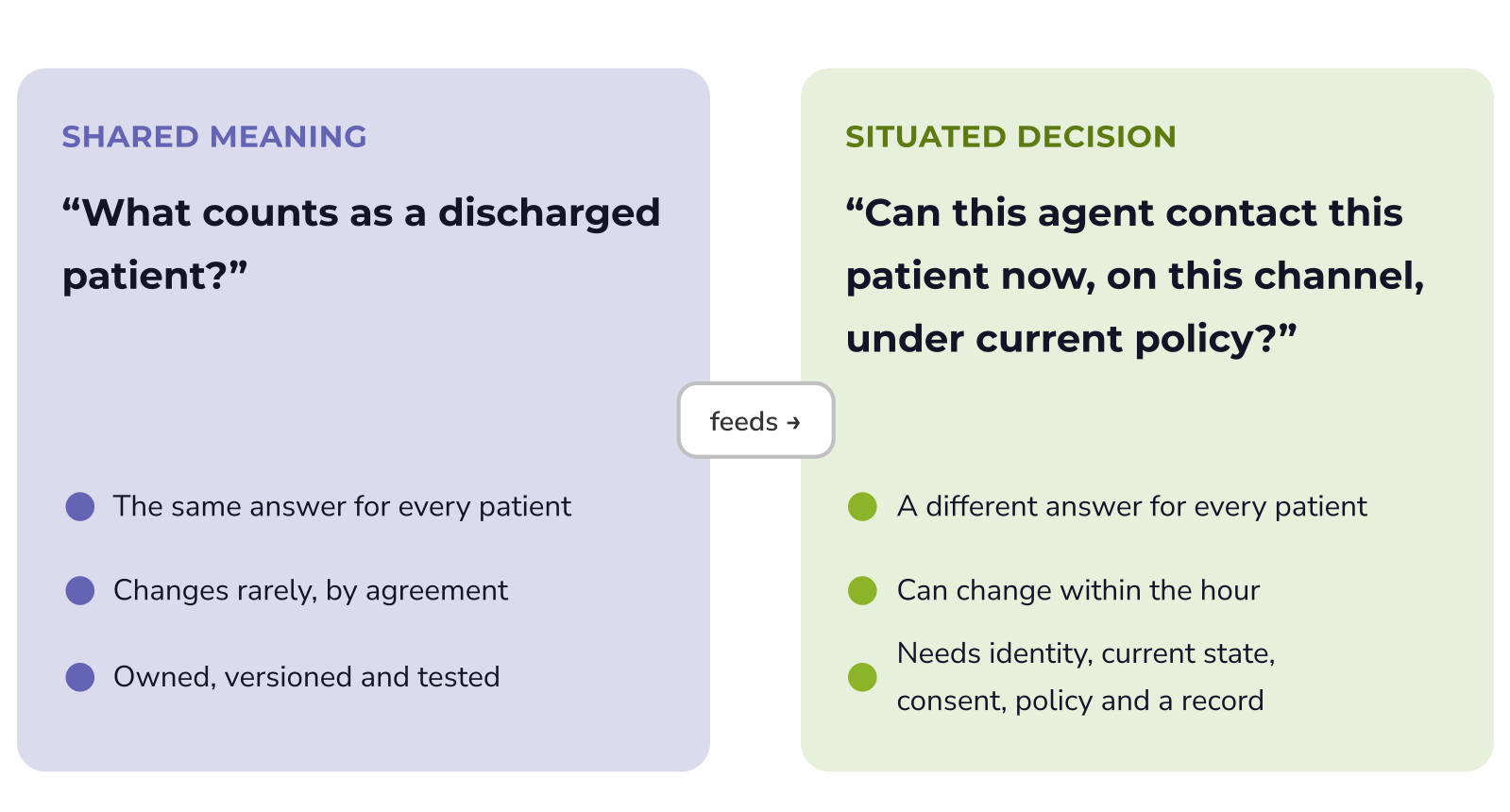
The same word, two different questions. An illustrative example: the first question is about meaning; the second is about one patient, right now, under current rules.
What a semantic layer does well
A semantic layer is where an organization defines its business terms and metrics once, so that every report and tool calculates them the same way. The idea is not new. Business Objects filed a patent in 1991 for a layer of familiar business terms that wrote the database queries for the user.3 Today, products such as the dbt Semantic Layer keep each metric definition in one place, so that a change reaches everywhere the metric is used.4
There is reasonable evidence that this helps. Airbnb’s metrics platform held more than 12,000 metrics by 2021. When travel collapsed in March 2020, the key metrics were already defined, so the central analytics team had a first executive dashboard running within a few days.2
Shared meaning helps AI, too. In a 2023 benchmark built on an insurance data model, GPT-4 answered 16.7% of business questions correctly when it was given only the raw database schema. Given an ontology and mappings that described the business, it answered 54.2% correctly.5 The test used one model and sample data, and its authors work for a data catalog company, so the exact numbers deserve caution. The direction is still clear.
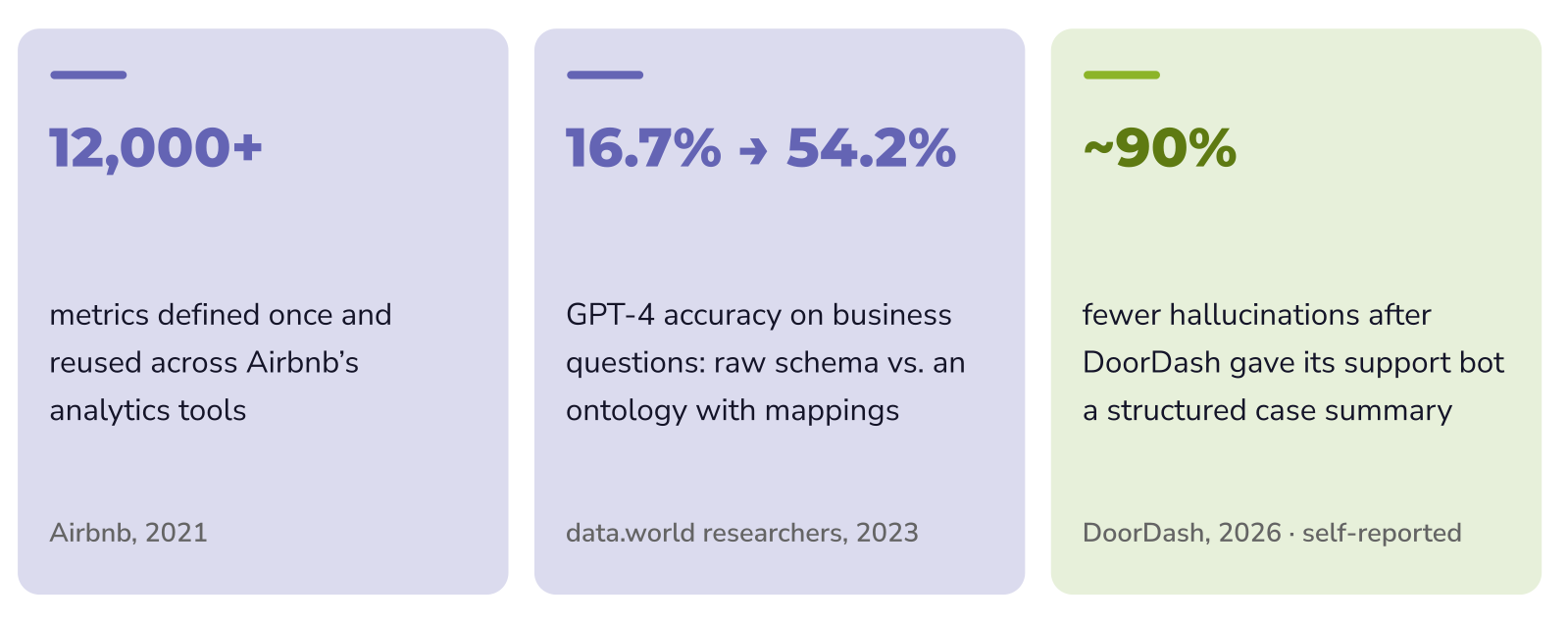
Evidence that structure helps. The third figure is self-reported by DoorDash and is discussed below.2,5,8
Where it stops
Every question in that benchmark was a read-only query. None asked the model to do anything.
That distinction matters more each year, because more AI systems now act. They issue refunds, send messages and update records. A metric definition cannot tell an agent which customer is in front of it, whether its information is current, or whether the person asking is allowed to approve what it is about to do.
Two pieces of evidence point at the gap. First, realistic enterprise work is harder than academic tests suggest. In the Spider 2.0 benchmark, an agent built on OpenAI’s o1-preview solved 21.3% of tasks drawn from real enterprise data workflows, compared with 91.2% on an older academic benchmark.6 Second, security guidance now treats action as a risk in its own right. OWASP lists excessive agency, meaning agents with too much functionality, too many permissions or too much autonomy, among the top risks for LLM applications. It advises checking authorization in downstream systems rather than leaving that decision to the model.7
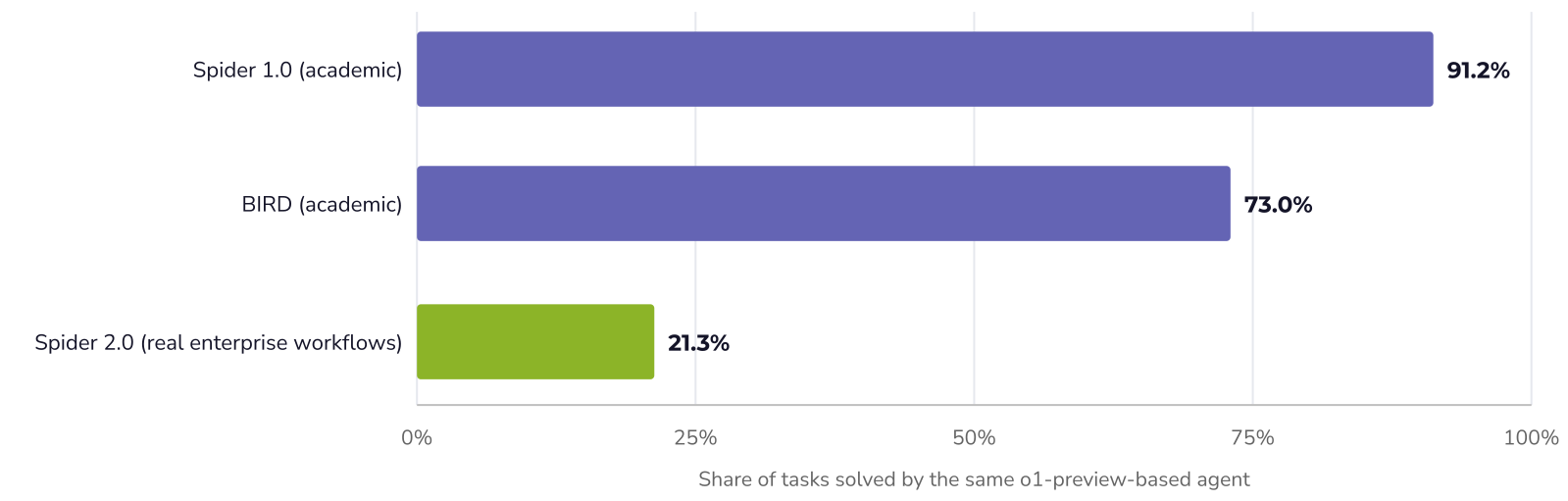
Realistic tasks are harder. Results for one o1-preview-based agent, as reported by the Spider 2.0 authors; later leaderboard entries score higher.6
There is also encouraging evidence that giving an agent the right context, in the right shape, helps. DoorDash found that its support chatbot was overwhelmed by the raw logs in its context, which led it to misread fields and suggest policies that did not exist. The team built a structured summary of each case, which it calls the case state. It reports that hallucinations fell by about 90% in testing and that the improvement held in production.8 That result is self-reported, but the lesson is useful: better-shaped context, not simply more of it.
A simple way to picture the difference
We find one analogy helpful. A semantic layer is the company’s dictionary and calculator. It fixes what “active customer” means and computes it the same way everywhere. A context layer is the case file an assistant needs before it acts: which customer this is, what is true about them now, where each fact came from, which policy applies and what the person asking may do.
The dictionary feeds the case file. Neither replaces the other.
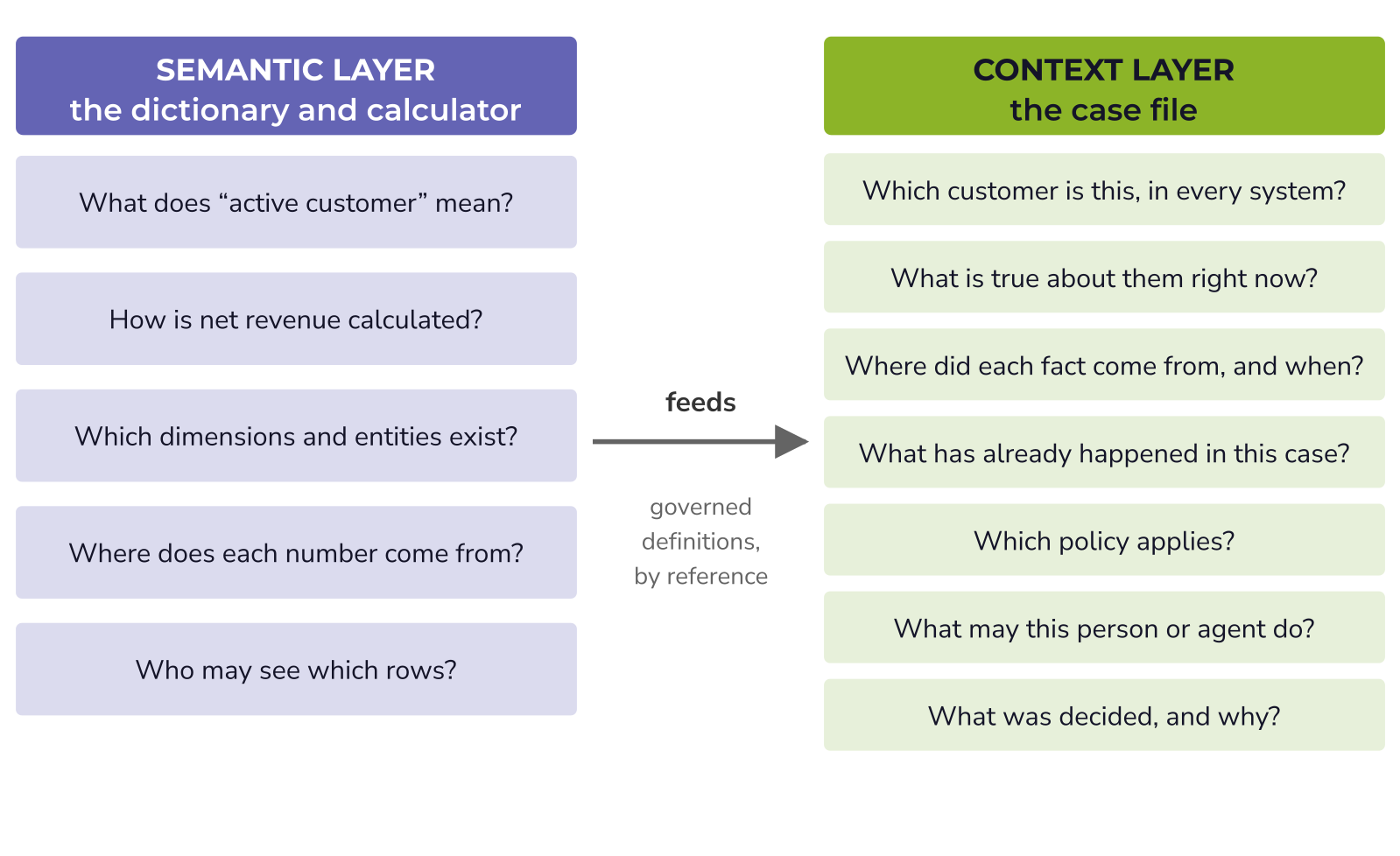
The dictionary and the case file. Governed definitions flow into each decision by reference, rather than being re-derived by the agent.
The words are muddled, so test what the system can do
Vendors do not use these terms consistently. Microsoft describes its Fabric ontology as a common context layer.9 Palantir’s own summary of its platform says its Ontology is not a semantic layer.10 Gartner notes that Microsoft’s separate IQ products do not yet share a way to confirm that a customer in one is the same customer in another.11
With usage this varied, labels are not much help. In the white paper we propose a five-part test instead. A workflow has what we call a context layer only if it can show all five of the following on real or simulated cases.
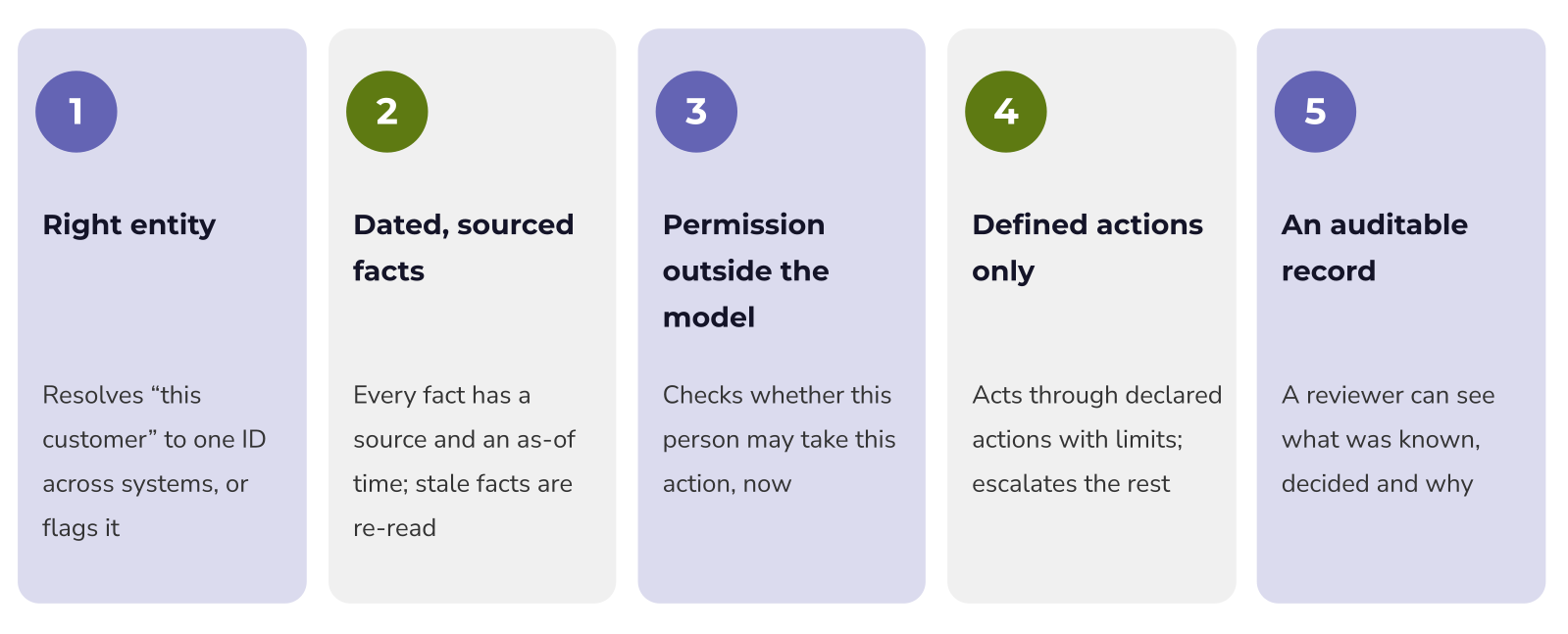
The five-part test, summarized. The white paper sets out each check and how to observe it.
Where should you start?
Two questions usually point to the first investment. How much do people disagree about what the terms mean? And how costly would it be to act on a wrong, stale or unauthorized view?
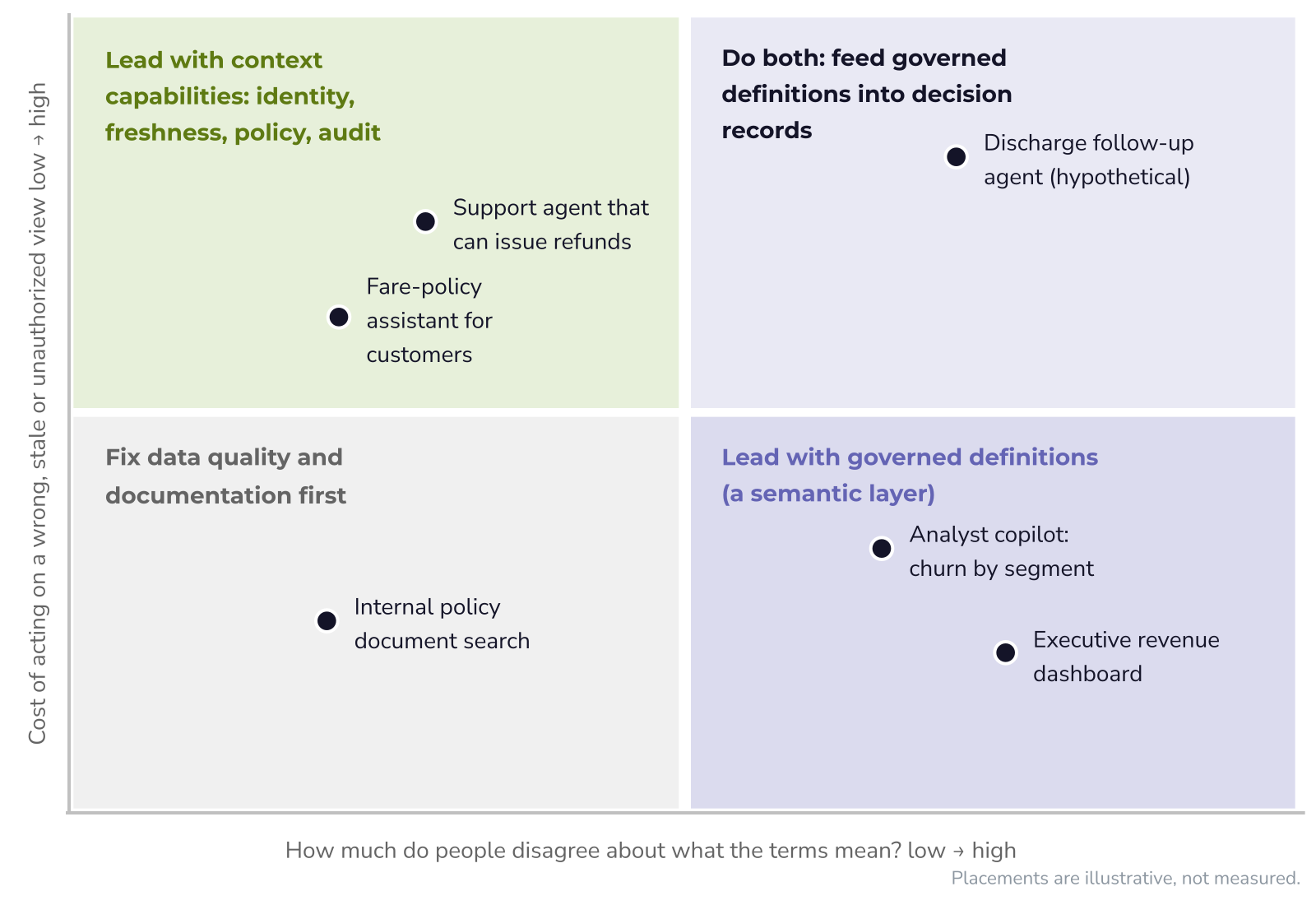
A two-question triage. Placements are illustrative, not measured.
An executive revenue dashboard usually needs governed definitions and little else. A support agent that can issue refunds needs current, case-specific facts and permission checks. Some workflows need both, such as a hospital agent that follows up with patients after discharge.
Before buying anything, check what you already run. Some platforms now cover parts of this. AWS, for example, can check each tool call that passes through its AgentCore gateway against written policies before the call runs.12 Often the job is to extend and test existing tools, not to add a new one. The four questions below are a quick way to decide.
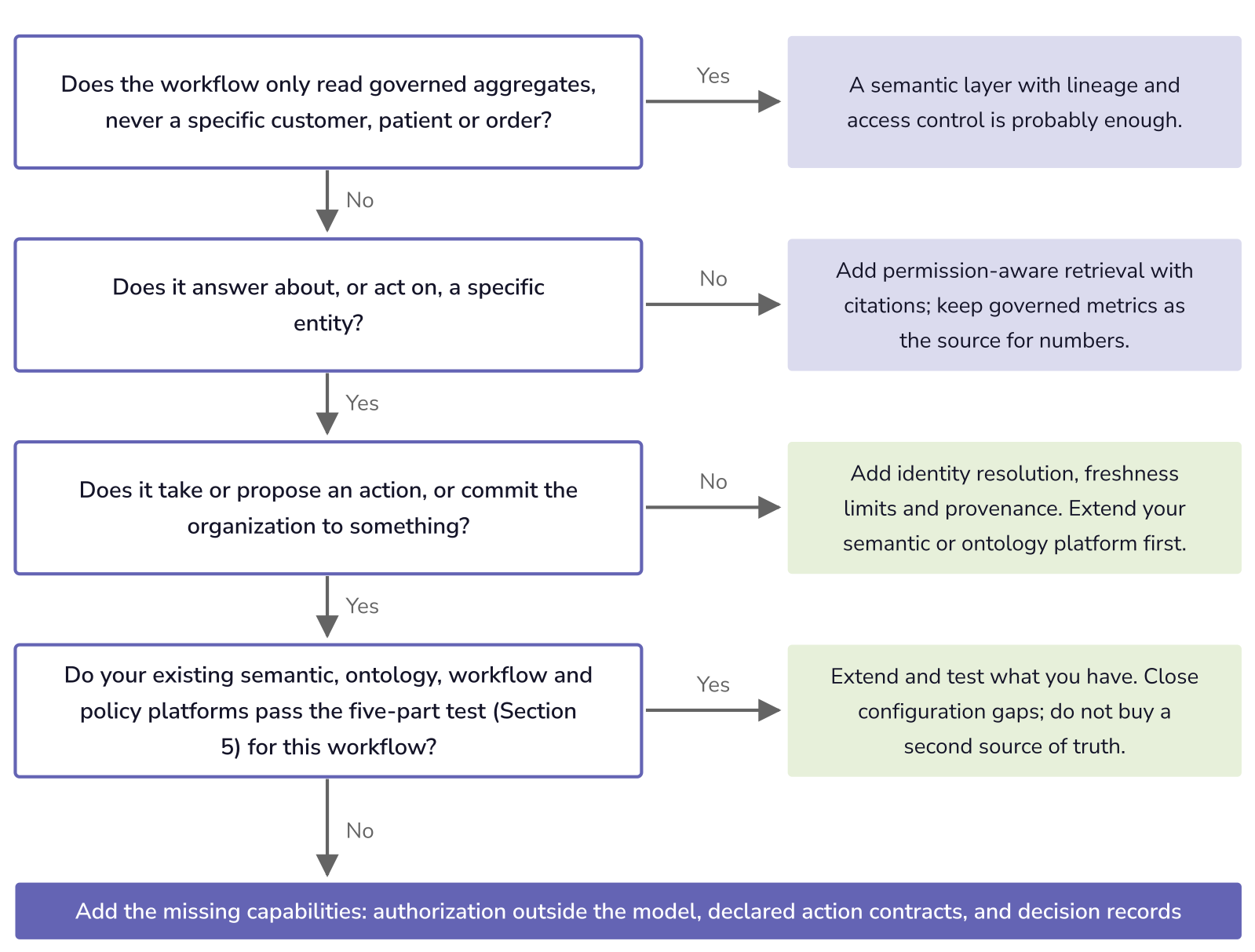
A four-question necessity test, taken from the white paper.
Three questions for your next architecture review
- For this workflow, which facts must be true right now, and how old is too old?
- Where is the decision about whether this requester may take this action made, and is it outside the model?
- If a customer or regulator asks why the system did what it did, can we rebuild the answer from records?
A word of caution. We found no independent study that measures how often these failures happen across companies, and the best-documented cases are self-reported. Measuring your own workflows is the honest place to start.
Sources
All sources accessed 23 November 2026. Company case studies are self-reported.
- American Bar Association, Business Law Today. “BC Tribunal Confirms Companies Remain Liable for Information Provided by AI Chatbot.” February 2024. https://www.americanbar.org/groups/business_law/resources/business-law-today/2024-february/bc-tribunal-confirms-companies-remain-liable-information-provided-ai-chatbot/
- Airbnb Tech Blog. “How Airbnb Achieved Metric Consistency at Scale. Part I: Introducing Minerva.” 30 April 2021. https://medium.com/airbnb-engineering/how-airbnb-achieved-metric-consistency-at-scale-f23cc53dea70
- Business Objects. US Patent 5,555,403, “Relational database access system using semantically dynamic objects.” Application filed 1991. https://patents.google.com/patent/US5555403
- dbt Labs. “dbt Semantic Layer.” Product documentation. https://docs.getdbt.com/docs/use-dbt-semantic-layer/dbt-semantic-layer
- Sequeda, Allemang and Jacob. “A Benchmark to Understand the Role of Knowledge Graphs on Large Language Model’s Accuracy for Question Answering on Enterprise SQL Databases.” arXiv:2311.07509, 2023. https://arxiv.org/abs/2311.07509
- Lei et al. “Spider 2.0: Evaluating Language Models on Real-World Enterprise Text-to-SQL Workflows.” ICLR 2025. https://arxiv.org/abs/2411.07763
- OWASP GenAI Security Project. “LLM06:2025 Excessive Agency.” https://genai.owasp.org/llmrisk/llm062025-excessive-agency/
- DoorDash Engineering. “A simulation and evaluation flywheel to develop LLM chatbots at scale.” 26 January 2026. https://careersatdoordash.com/?p=15635
- Microsoft Learn. “What is ontology (preview)?” Last updated 16 October 2026. https://learn.microsoft.com/en-us/fabric/iq/ontology/overview
- Palantir. “Foundry platform summary for LLMs.” Last updated 2 July 2026. https://palantir.com/docs/jp/foundry/getting-started/foundry-platform-summary-llm/
- Gartner. “Microsoft’s Fabric IQ Updates Make Ontologies Operational.” First Take, 19 October 2026. https://www.gartner.com/en/insights/gartner-first-takes/microsoft-fabric-iq
- Amazon Web Services. “Policy in Amazon Bedrock AgentCore: Control agent interactions.” Developer guide. https://docs.aws.amazon.com/bedrock-agentcore/latest/devguide/policy.html
Download Whitepaper
Shared Meaning, Situated Decisions
Enterprise semantic layers and context layers in practice. What AI agents need beyond governed metrics, and when an organization actually needs something new.