




The Intelligence Imperative
A Strategic White Paper for Enterprise Technology & Strategy Leaders
How much of your AI budget is going to work that doesn’t need it? Download our latest white paper on right-sizing enterprise intelligence — with real cost benchmarks, a tiered architecture model, and a compliance framework built for regulated industries.
Here is what is actually happening inside most enterprise AI programs right now. Someone runs a pilot. It works. Leadership gets excited. Budget flows. Six months later, the bills are bigger, the use cases are multiplying, and the finance team is asking a question no one budgeted time to answer: what exactly are we getting for this?
The problem is not that AI does not create value. It does. The problem is that most enterprises are buying intelligence the same way someone shops for a car by only looking at the most expensive model on the lot — then wondering why their fuel costs are high.
The Scale of the Problem
Between 2024 and 2025, the average enterprise increased its reasoning token consumption by 320× (OpenAI internal data). Agentic AI workflows — where models plan, act, and self-correct in multi-step loops — consume 100 to 1,000× more tokens than a simple chatbot exchange. If you are routing all of that through frontier APIs, you are not managing an AI program. You are managing an uncapped cost line.
The Overthinking Problem Nobody Talks About
Amazon researchers published something that should have changed how every enterprise thinks about AI costs: reasoning models — the expensive, chain-of-thought systems sold as the gold standard — generate seven to ten times more tokens than they need to answer routine questions. They are, in a very literal sense, overthinking the problem.
There is a concept called the intelligence threshold. Every task has a capability floor — the minimum amount of reasoning required to produce a correct answer. Below that floor, the model gets things wrong. Above it, you are paying for cognitive effort that changes nothing about the output. Most enterprise work sits well below the threshold of frontier AI. Drafting a standard contract clause. Extracting data from a structured report. Routing a support ticket. Summarizing a meeting. These tasks do not need a model that can write a doctoral thesis. They need a model that is accurate, fast, and cheap.
Why Your AI Bill Keeps Growing
The default pattern for enterprise AI in 2024 was to point everything at the best available cloud model and measure quality. That made sense when token volumes were manageable. It stops making sense when volumes scale.
When Anthropic restricts its newest model to forty organizations, it is not making a pricing decision — it is making a rationing decision. When GPU spot prices jump 48% in sixty days (which they did in early 2026), that is not a market anomaly — it is the leading edge of a structural supply shortage that Bank of America projects will persist through 2029. The enterprises that built their AI cost structure assuming frontier access would stay cheap and unlimited are now recalculating.
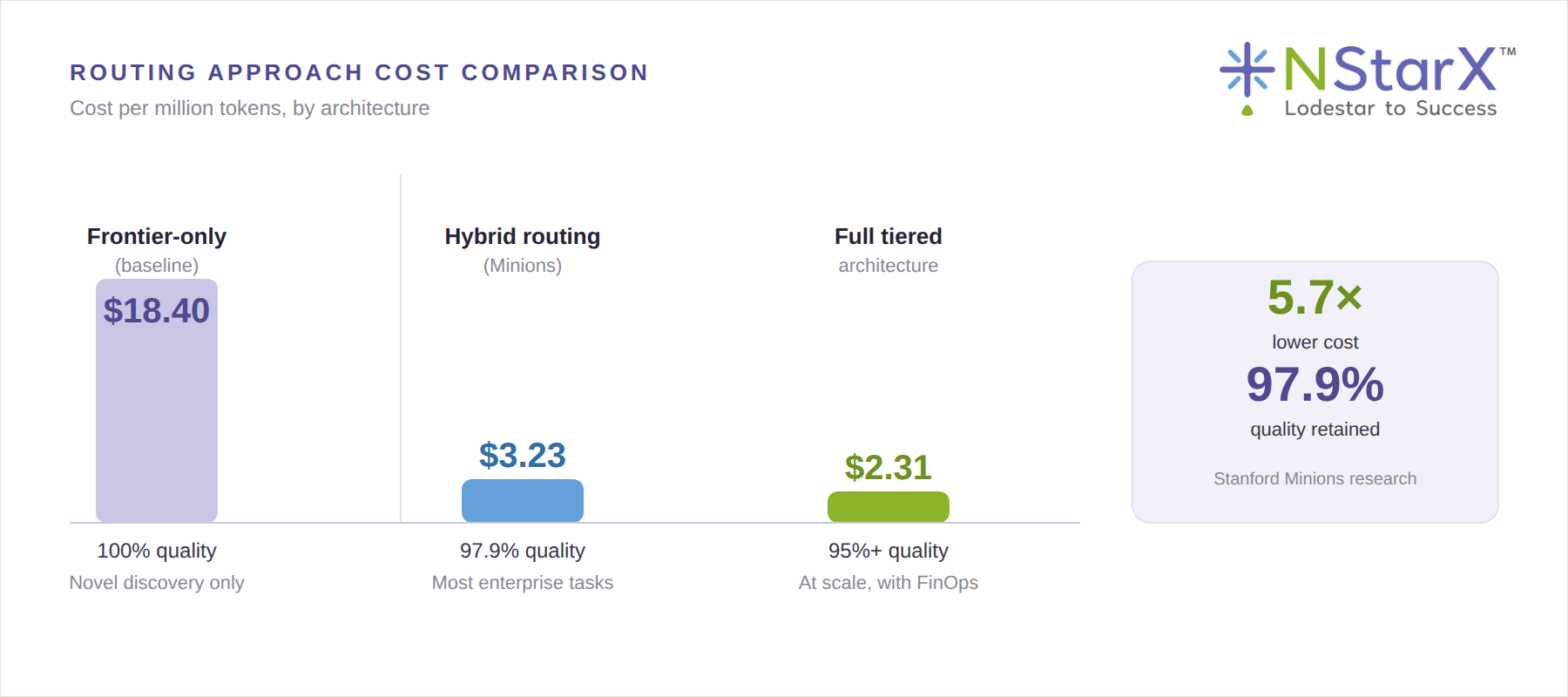
Source: Stanford Minions research (Abdin et al., 2025); NStarX enterprise routing benchmark, Q1 2026.
The 97.9% quality retention figure at 5.7× lower cost comes from Stanford’s Minions research — a rigorous study of hybrid local-frontier workflows on real enterprise tasks. The gap between $18.40 and $2.31 per million tokens is not theoretical. It is what organizations that have built tiered intelligence infrastructure are actually spending.
The Intelligence Debt Risk
Organizations that are not actively managing their AI programs — evaluating model performance, retraining on organizational data, building FinOps attribution — are accumulating what we call intelligence debt. Their models degrade relative to competitors who are. Their costs drift upward without accountability. Their regulated-data exposure grows without governance. The debt does not announce itself. It compounds quietly until it becomes a crisis.
The Architecture That Changes the Math
The enterprises that are getting AI right are not using better models. They are using the right model for each task — and they have built the infrastructure to make that routing automatic, governed, and measurable.
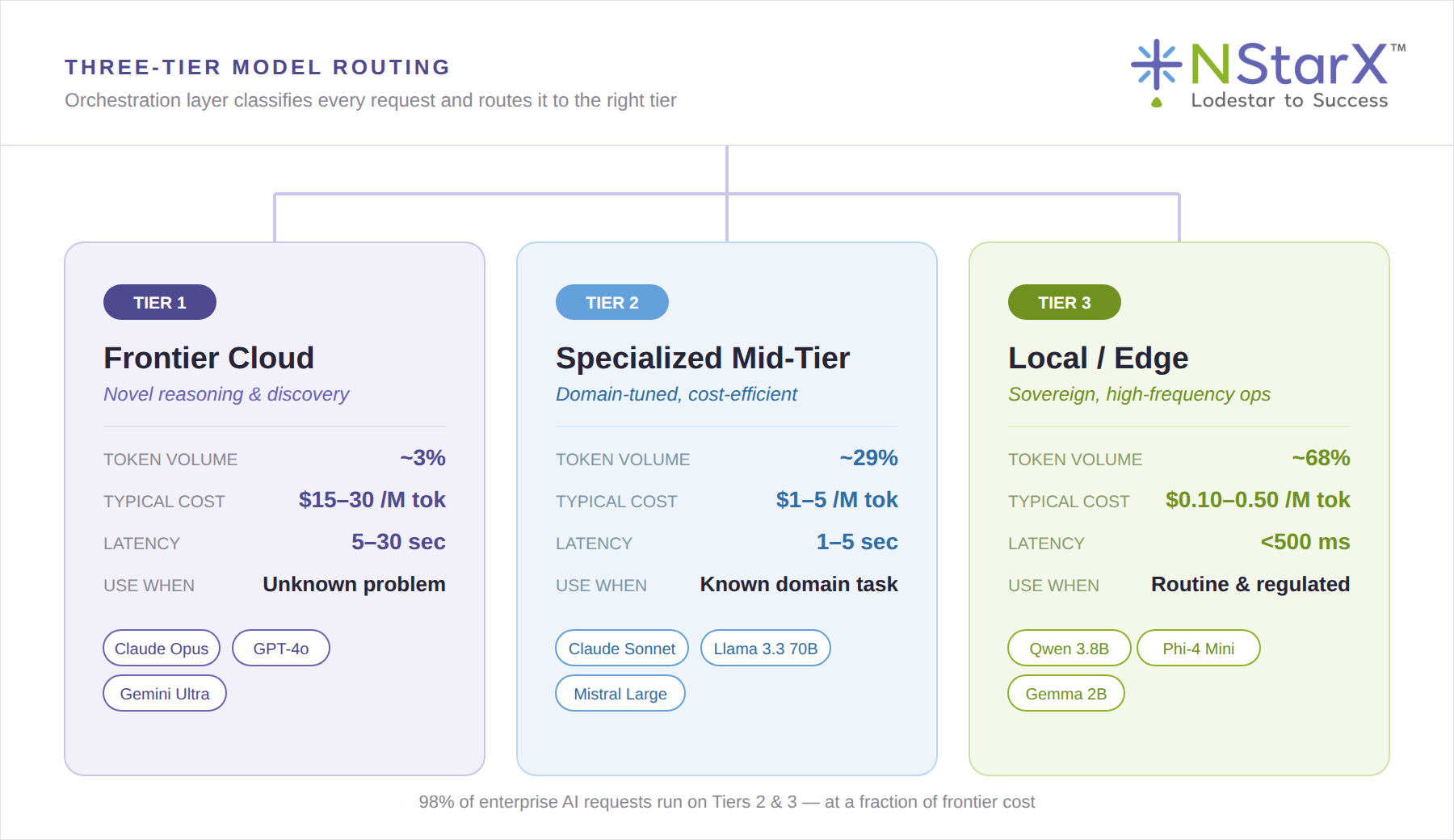
Three-tier model routing: Frontier (3% of volume) · Specialized (29%) · Local/Edge (68%)
The tiered architecture works like this. Ninety-eight percent of enterprise AI requests — document processing, data extraction, content classification, customer communication — can be handled by specialized mid-tier or local models running at a fraction of the cost of frontier APIs. The two percent that genuinely require frontier reasoning — novel legal analysis, drug interaction research, complex financial modeling with ambiguous inputs — get routed there specifically, with full cost attribution.
The orchestration layer sitting between your applications and your model tiers is the actual product. It classifies intent. It enforces data governance. It compresses context. It tracks every token against a budget. And in regulated industries — healthcare, finance, defense — it ensures that sensitive data never crosses a boundary it is not permitted to cross.
“The model is a commodity. The context, governance, evaluation infrastructure, and operational discipline surrounding it are not. That is where the real competitive advantage is built.”
— NStarX · The Intelligence Imperative, 2026
What the Next Three Years Look Like
Intelligence is commoditizing at the capability level. The gap between open-weight models and frontier APIs has collapsed faster than almost anyone predicted. Qwen3 at 8 billion parameters is matching Anthropic’s best model on standardized benchmarks. The cost of a given capability is dropping 67% year-over-year. By 2028, the models themselves will be infrastructure — like compute or bandwidth — and the competitive differentiation will live entirely in who built the better system around them.
At the same time, access to the genuinely novel reasoning capabilities — the things only the frontier models can do — is concentrating. Multi-year contracts with the major labs. Strategic data partnerships. Early access programs limited to organizations that have already built the infrastructure to use them productively. The window to establish those relationships is narrowing. Organizations that have historically moved slowly on technology procurement are learning that waiting for AI to feel safe before acting may mean arriving after the best seats are already taken.
This article is a summary of The Intelligence Imperative: Right-Sizing Enterprise AI Spend — a 50-page white paper published by NStarX in August 2026. All statistics are sourced from publicly available research; full citations appear in the white paper.
Download Whitepaper
The Intelligence Imperative
A Strategic White Paper for Enterprise Technology & Strategy Leaders
How much of your AI budget is going to work that doesn’t need it? Download our latest white paper on right-sizing enterprise intelligence — with real cost benchmarks, a tiered architecture model, and a compliance framework built for regulated industries.