




Enterprise AI Architecture Convergence: Context Engineering · Memory Optimization · Federated Architecture · AI FinOps
A Strategic White Paper for Enterprise Architecture Leaders
The enterprise AI programs that reach production scale aren’t running better models — they’re running better architecture. This white paper maps the four disciplines every enterprise AI platform must integrate: Context Engineering, Memory Optimisation, Federated Architecture, and AI FinOps. Download your copy and build the foundation that makes AI capability stick.
Introduction: The Architecture Beneath the Models
Most enterprise AI programs fail not because the models are insufficient, but because the architecture surrounding them was never designed in the first place.
The last three years produced a curious paradox in enterprise technology. Organizations gained access to models of extraordinary capability — systems that can draft contracts, synthesize research, generate code, and reason across complex multi-step problems. Yet the percentage of enterprise AI pilots that reach production scale remains stubbornly low. The quality of AI outputs in production environments disappoints relative to what the same models demonstrate in demos. Costs escalate in ways that budgets did not anticipate. Governance reviews surface risks that were not visible at the pilot stage.
The explanation is architectural. Enterprise AI capability is determined less by the models themselves and more by the architecture that governs what those models know at inference time, what they remember across interactions, where they are allowed to reason relative to governed data, and how the economics of that reasoning are managed at scale. These four concerns — Context Engineering, Memory Optimization, Federated Architecture, and AI FinOps — are not independent workstreams. They are the integrated architecture beneath the models.
This post develops that argument in depth, with reference diagrams that map each discipline and their convergence into a unified enterprise platform.
Who This Is For
This analysis is written for enterprise architecture leaders, CIOs, CDOs, and AI platform teams who are moving beyond pilot programs and need a coherent architectural framework for production-grade AI at scale.
The Convergence Thesis: Four Disciplines, One Architecture
Organizations that treat Context Engineering, Memory Optimization, Federated Architecture, and AI FinOps as separate workstreams will continue to experience the production failures that characterize today’s enterprise AI landscape.
The four disciplines emerged from different professional communities and have largely been developed in isolation. Context Engineering grew from information retrieval and RAG pipeline research. Memory Optimization has roots in cognitive architecture and long-running agent design. Federated Architecture is a product of distributed systems and regulatory compliance engineering. AI FinOps is cloud FinOps adapted to inference economics. Each community has produced valuable frameworks within its own domain.
The problem is that these domains interact in ways that make isolated optimization counterproductive. A context engineering decision that maximizes retrieval precision may inflate token volume in ways that create FinOps cost problems. A memory architecture designed for recall quality may create data residency issues that require federated design to resolve. A federated topology that preserves sovereignty may impose latency and cost constraints that require FinOps optimization to manage. None of these trade-offs is visible when you are looking at only one discipline.
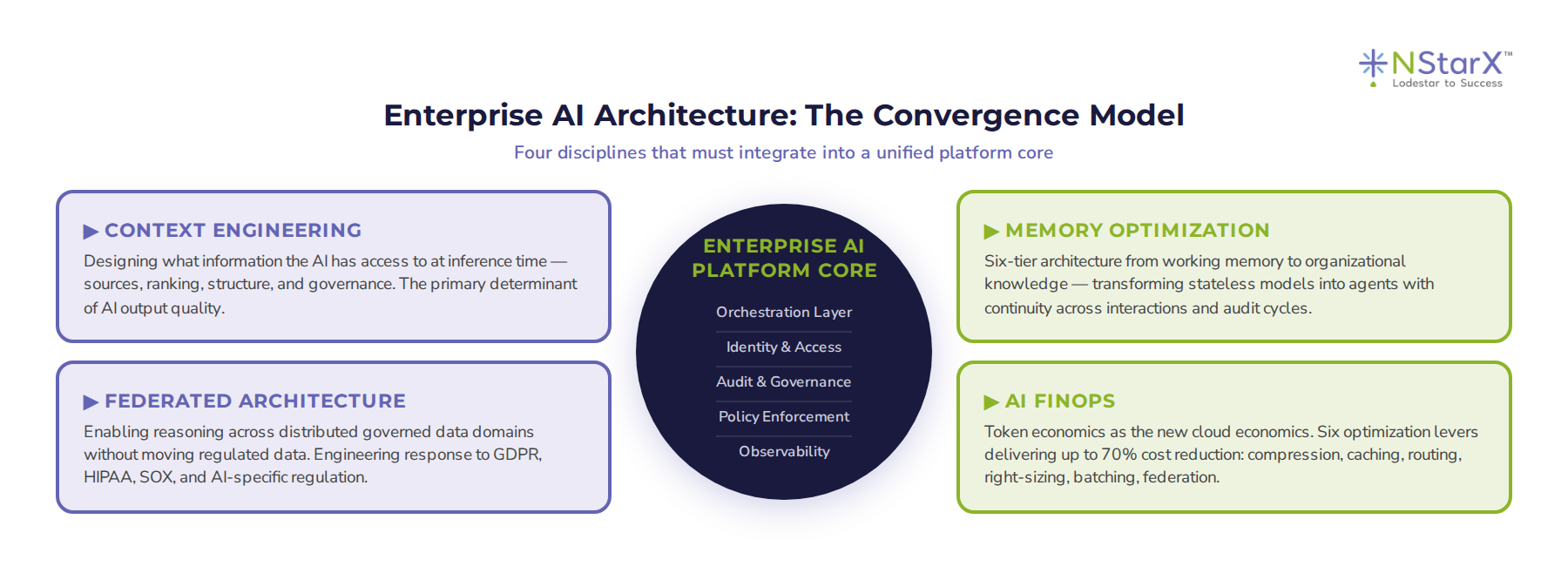
Figure 1 — Enterprise AI Architecture Convergence Model: four disciplines integrating into a unified platform core
The convergence model is not theoretical. It describes the architectural state that organizations reach — usually after considerable trial and error — when they begin treating enterprise AI as an engineering discipline rather than a technology procurement exercise. The organizations that reach it deliberately, by design, rather than by iterating through failures, establish durable competitive advantage.
The Three Failure Modes of Fragmented Architecture
Context Collapse: AI agents are only as effective as the context they operate within. When context is assembled opportunistically — pulling from whatever data sources are most accessible — agents become partially informed, inconsistently grounded, and prone to confident errors. Context collapse is particularly acute in multi-step agentic workflows, where each reasoning step consumes context budget that subsequent steps cannot recover.
State Amnesia: Enterprise business processes are not stateless. Procurement workflows span days. Customer relationships span years. Regulatory compliance reviews span audit cycles. Agents designed with session-scoped memory cannot maintain coherent state across these timescales — and when they fail to do so, the consequences are not just poor user experience but audit trail gaps and inconsistent decisions that carry compliance risk.
Sovereignty Violations: The default AI architecture pattern — send data to a centralized model, receive inference — creates structural data sovereignty problems in regulated industries. Organizations discover this constraint late, after significant investment in centralized architectures that must then be partially dismantled. Federated design is the engineering response to a legal and regulatory reality that most enterprises encounter before they have budgeted for it.
Context Engineering: Designing What the AI Knows
Context Engineering is the discipline of deliberately designing what information an AI system has access to at inference time, and how that information is structured, ranked, and governed.
The distinction between prompt engineering and context engineering is not semantic. Prompt engineering is a communication skill — it concerns how a question is framed. Context Engineering is an architecture discipline — it concerns what information the AI system has access to when it processes that question. An AI with a poorly engineered context will produce unreliable outputs regardless of how well the prompt is crafted.
Enterprise AI systems draw context from a heterogeneous taxonomy of sources: systems of record (ERP, CRM, HRMS), knowledge repositories (documentation, wikis, SharePoint), communication streams (email, Slack, meeting transcripts), external intelligence feeds, operational telemetry, and identity and access context that governs what each user is entitled to see. Designing how each of these sources contributes to inference-time context — and how conflicts between sources are resolved — is the work of context engineering.
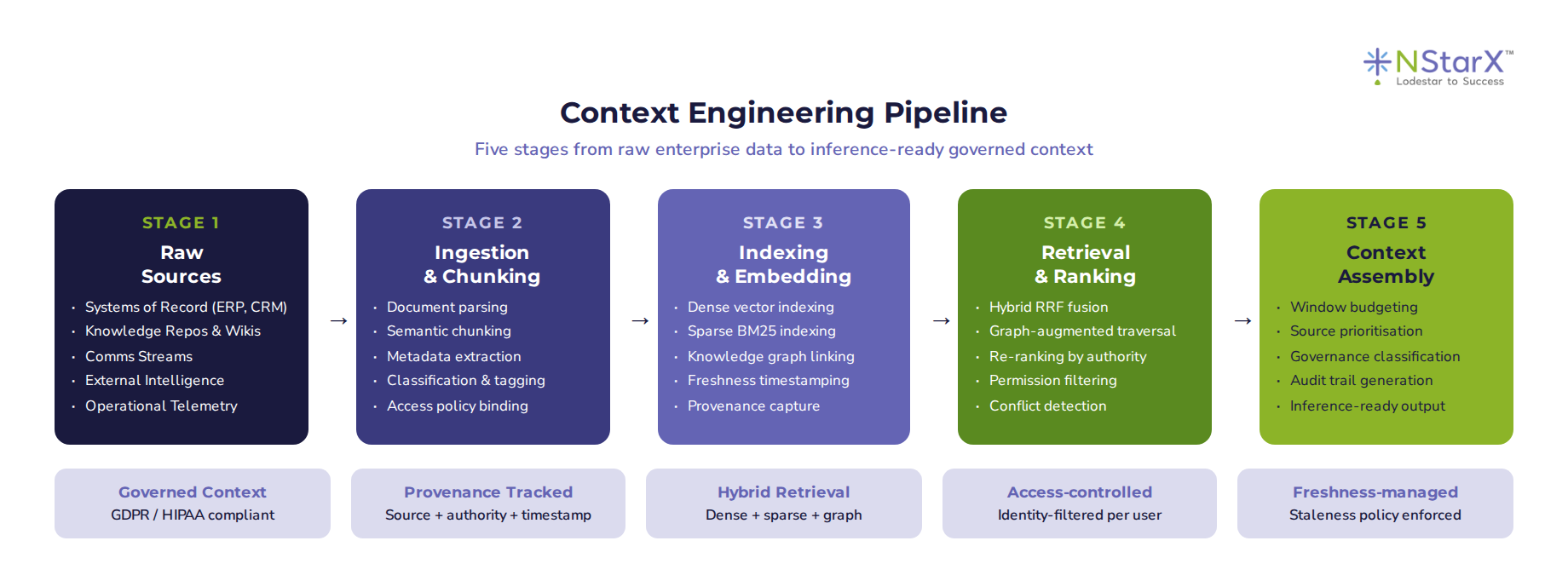
Figure 2 — Context Engineering Pipeline: five stages from raw data source to inference-ready context assembly
The Four Retrieval Strategies
Retrieval is the operational core of context engineering. The selection of retrieval strategy determines the quality ceiling of every AI output the system produces. Four strategies — not mutually exclusive — define the current enterprise design space.
- Dense Vector Retrieval: Semantic similarity search over embedded document chunks. Effective for unstructured text retrieval where keyword matching is insufficient, but susceptible to retrieving conceptually similar but factually inapplicable content at scale.
- Sparse Keyword Retrieval (BM25): Precise term-frequency ranking. More brittle for natural language but more reliable for exact-match requirements — regulatory text, contract clauses, reference standards — where precise terminology is normative, not stylistic.
- Hybrid Retrieval (RRF Fusion): The current best practice for most enterprise deployments. Reciprocal Rank Fusion combines dense and sparse scores, reducing the failure modes of either approach alone at the cost of increased infrastructure complexity.
- Graph-Augmented Retrieval: Traversal of knowledge graph relationships before or after vector search. Essential for domains where entities have complex relationships — supply chains, organizational hierarchies, regulatory dependency trees — resolving the ‘right document, wrong entity’ problem that pure vector retrieval cannot address.
Context Lifecycle: The Dimension Most Architectures Miss
Context is not static. Regulatory requirements update. Products are modified. Personnel change roles. A context engineering architecture must address not just how context is assembled but how it is maintained over time. Freshness policies define acceptable staleness thresholds by source type. Conflict detection identifies when authoritative sources provide contradictory information. Provenance tracking ensures every context item carries its source, timestamp, authority level, and governance classification — enabling audit reconstruction and helping AI systems reason about the reliability of their own context.
Architecture Principle
Context quality is the primary determinant of AI output quality. No amount of prompt engineering or model sophistication will compensate for a context layer that is stale, conflicted, or ungoverned. Invest in context architecture before investing in model capability.
Memory Optimization: Building AI That Remembers
Enterprise AI agents that cannot maintain state across interactions are expensive tools, not intelligent systems. Memory architecture is what transforms capability into continuity.
The memory problem in enterprise AI is simultaneously technical and organizational. On the technical side, language models are stateless — they retain nothing between inference calls unless that information is explicitly provided in the context window. On the organizational side, enterprise business processes assume state continuity in ways so fundamental that they are rarely articulated until an AI system violates them. The customer who has to re-explain their situation to an AI that has no recall of their prior interactions has encountered a memory architecture gap, not a model capability gap.
A practical enterprise memory architecture distinguishes six tiers, each with different storage characteristics, retrieval patterns, and governance requirements.
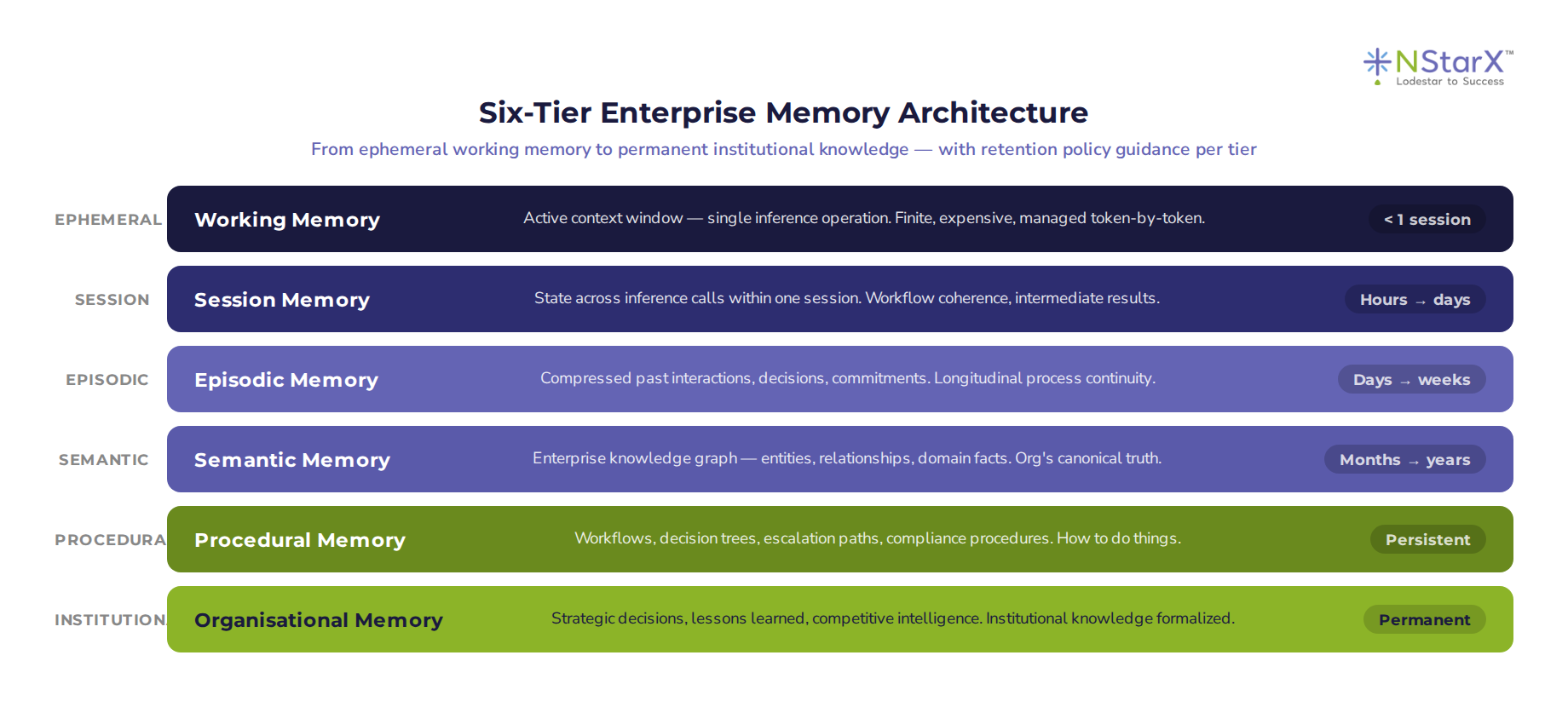
Figure 3 — Six-tier Enterprise Memory Architecture with retention policy guidance per tier
The Six Memory Tiers
| Memory Tier | Description | Retention Policy |
|---|---|---|
| Working Memory | The active context window — information immediately available to the model during a single inference operation. Finite, expensive, and ephemeral by default. | Summarize at token threshold; discard raw turns post-summary |
| Session Memory | Structured state maintained across inference calls within a single user session or workflow execution. Enables conversational coherence and workflow state tracking. | Persist for session + grace period; compress to episodic on close |
| Episodic Memory | Compressed representations of significant past interactions, decisions, and events. Allows agents to recall prior sessions and build longitudinal understanding. | High-sig events: indefinite; low-sig: compress at 90 days |
| Semantic Memory | The enterprise knowledge graph — entities, relationships, and factual knowledge about the organization’s domain. | Version-controlled with eff. dates; purge only on governance review |
| Procedural Memory | Workflows, decision trees, escalation paths, and compliance procedures — encodes how to perform tasks. | Aligned to procedure governance; tested on agent behavior update |
| Organizational Memory | Accumulated institutional knowledge: strategic decisions, lessons learned, competitive intelligence, and domain expertise not yet written down. | No auto-expiry; explicit review for archival; redundant storage |
Memory Quality: The Operational Imperative
A memory store that appears comprehensive may contain conflicted, outdated, or misleading entries that degrade agent performance in ways that are difficult to diagnose without dedicated quality monitoring. Memory quality evaluation should be a first-class operational capability: consistency checks to detect contradictory entries across tiers, staleness monitoring to trigger refresh workflows, retrieval precision metrics to measure whether memory returns relevant results, and periodic agent behavior audits that trace decisions back to the memory content that informed them.
Design Principle
Build the memory layer before you need it. Memory architecture requirements are not apparent in proof of concept environments. They become urgent in production — when agents contradict prior decisions, users find the AI has no institutional memory, and audit teams cannot reconstruct what an agent knew when it made a consequential recommendation.
Federated Architecture: Intelligence at the Data Boundary
The question is not whether to federate. In regulated enterprises with distributed data estates, the question is how to federate without sacrificing reasoning quality.
Federated architecture for enterprise AI is the design pattern that enables intelligent reasoning across distributed systems of record without requiring those records to be consolidated into a central repository. It is architecturally more complex than centralized inference but legally necessary in virtually every regulated industry.
GDPR, CCPA, HIPAA, SOX, and a growing body of AI-specific regulation create data residency and access constraints that centralized AI architectures cannot accommodate without extensive — and often expensive — compliance engineering at the model endpoint. The organizations that discover this late, after significant investment in centralized designs, face the costly process of retrofitting federation onto an architecture built on centralized assumptions. The organizations that design for federation from the start treat it as what it is: an engineering response to a legal and regulatory reality that is known before the first line of architecture is drawn.
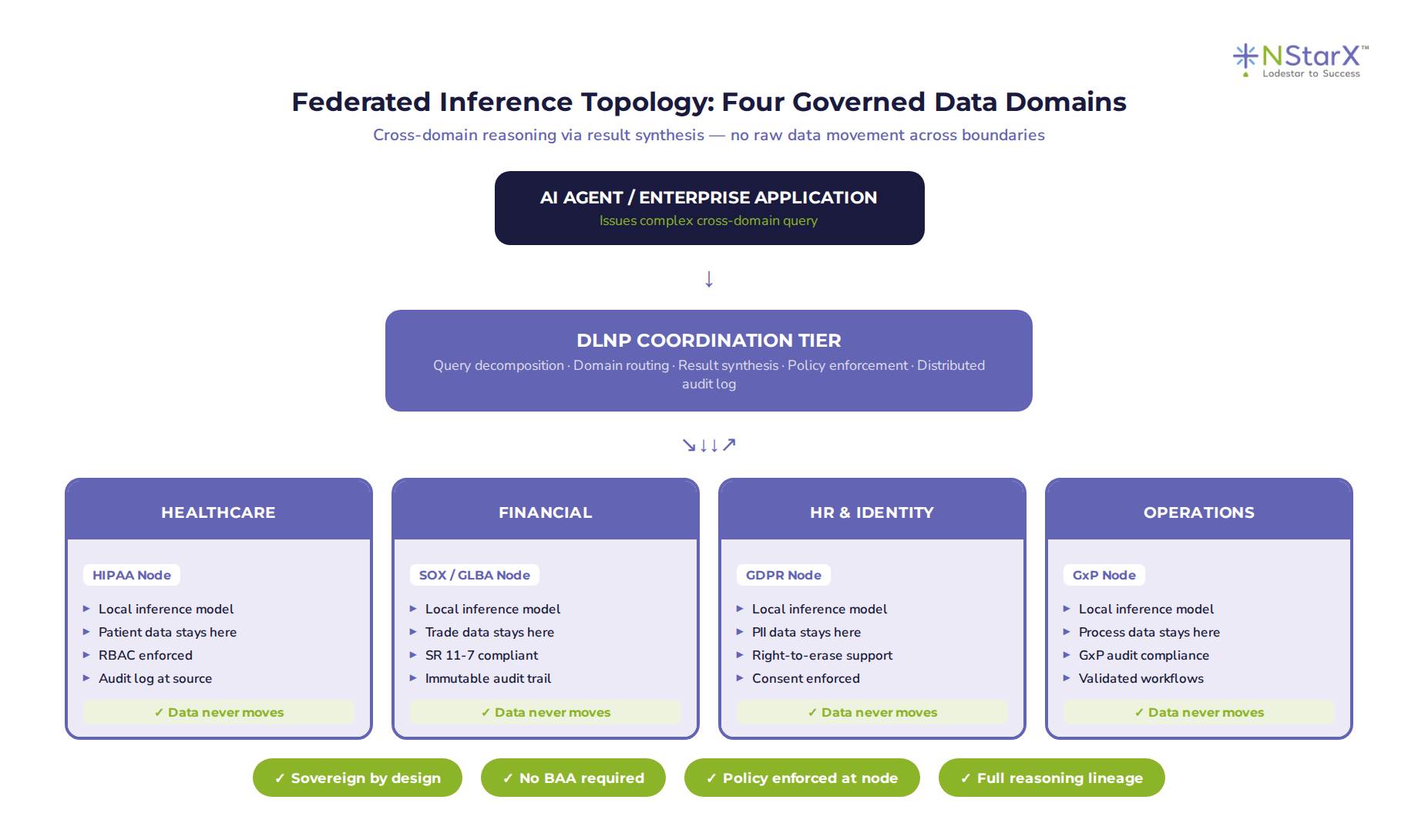
Figure 4 — Federated inference topology across four governed data domains, with centralized coordination and no raw data movement
The Four Federated Inference Patterns
Query Decomposition and Distribution: A coordination layer decomposes complex enterprise queries into sub-queries answerable by local models within their data domain. Results are aggregated and synthesized at the coordination tier. Cross-domain reasoning occurs at the result level, not the data level — no governed data moves.
Model Specialization and Routing: Domain-specific models are deployed within each data domain, trained or fine-tuned on domain-specific data. A routing layer directs requests to the appropriate domain model based on query classification. This pattern trades cross-domain coherence for domain specialization and sovereignty.
Federated Learning: Models are trained on local data partitions without sharing the data itself — only model updates (gradients or weights) are aggregated centrally. Federated learning enables models to benefit from distributed data without consolidating it, addressing both sovereignty and data gravity: moving model updates is orders of magnitude cheaper than moving enterprise data at scale.
Differential Privacy Overlays: When some data must contribute to centralized context or model training, differential privacy mechanisms can be applied to prevent reconstruction of individual records from aggregate outputs. This pattern enables participation in federated reasoning with mathematical guarantees about privacy preservation.
Governance Across Federated Nodes
Federation distributes governance rather than simplifying it. Policy propagation, distributed audit logging, and key management across federated nodes are the three governance challenges that most federated AI deployments underestimate. Policy-as-code frameworks that distribute enforcement logic to each node — rather than requiring central policy evaluation for every inference request — are architecturally preferred. Distributed audit logging with correlated trace identifiers enables reconstruction of the full reasoning lineage for any federated inference, satisfying audit requirements without centralizing the underlying data.
Regulatory Reality
Retrofitting federation onto a centralized AI architecture is expensive. It requires re-designing data access patterns, model deployment topologies, and audit logging infrastructure built on centralized assumptions. If your enterprise operates in regulated industries, design for federation from the start.
AI FinOps: The Economics of Enterprise Intelligence
Token economics are the new cloud economics. The organizations that mastered cloud cost management in the 2010s need to apply those lessons to inference costs now — before the bills arrive.
The enterprise AI cost problem is not widely understood before it becomes urgent. Proof of concept environments operate at token volumes that make cost management seem premature — a concern for later, after the technology is proven. Production deployments at enterprise scale — millions of tokens per hour across dozens of use cases — expose a cost structure that can rapidly overwhelm AI program budgets unless managed as a first-class engineering discipline from the beginning.
AI FinOps extends the cloud FinOps framework — developed over a decade of managing compute, storage, and network costs — to cover inference tokens, context tokens, memory operations, and agent compute as the primary cost units. The organizational practices are familiar: attribution, budgeting, chargeback, optimization. The measurement units and optimization levers are new.
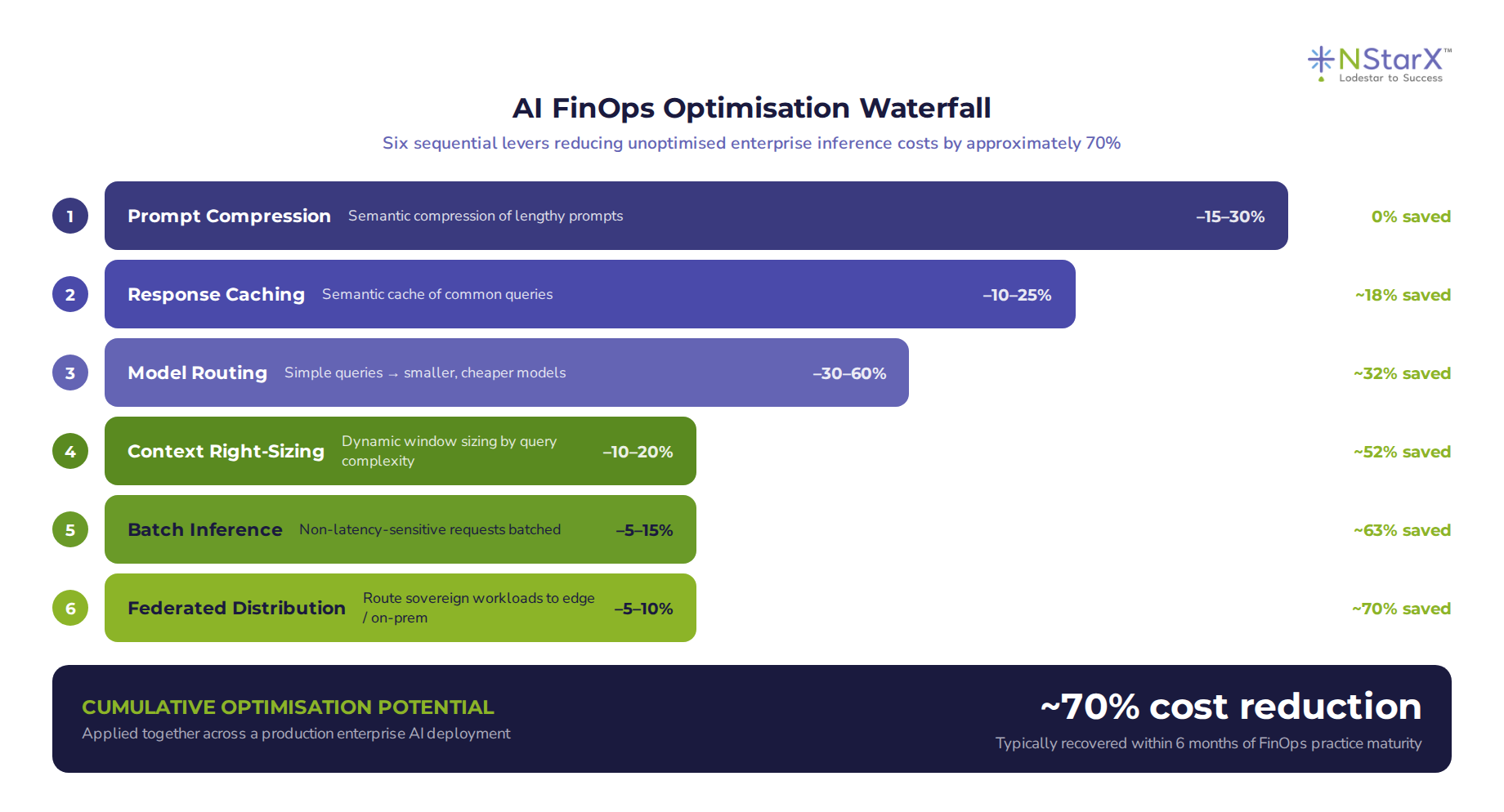
Figure 5 — AI FinOps optimization waterfall: cumulative cost reduction from six sequential optimization levers
The Six Optimization Levers
| Optimization Lever | Cost Reduction | Description |
|---|---|---|
| Prompt Compression | −15% | Semantic compression of lengthy prompts reduces input tokens 15–30% with minimal quality impact. The highest-leverage early optimization because it compounds with all downstream levers. |
| Response Caching | −18% | Semantic caching of common queries eliminates redundant inference for repetitive requests. Effective when query distributions are concentrated — which they typically are in enterprise use cases with defined workflows. |
| Model Routing | −14% | Directing simple queries to smaller, cheaper models while reserving frontier model capacity for complex reasoning. Mixed-complexity enterprise workloads typically see 30–60% cost reduction from intelligent routing alone. |
| Context Window Right-Sizing | −11% | Dynamic context window sizing based on query complexity avoids paying for context capacity that is not utilized. Most enterprise queries do not require the maximum context window of frontier models. |
| Batch Inference | −12% | Batching non-latency-sensitive requests reduces per-token inference cost. Suitable for document processing, overnight analytics, bulk generation, and workflows that do not require synchronous response. |
| Federated Cost Distribution | Ongoing | Routing inference to lower-cost edge or on-premises compute for data-sovereign workloads. Trades infrastructure investment for operating cost reduction over time — the FinOps–federation intersection. |
The AI FinOps Operating Model
Cost attribution is the foundational practice. Without attribution at the use case and business unit level, AI platform costs accumulate in centralized IT budgets with no incentive at the consumption level to optimize. Attribution requires instrumentation at the model API gateway with tagging that identifies the cost center, application, use case, and user type generating each inference request.
Chargeback models — where business units are billed for their AI consumption — create the incentive alignment necessary for decentralized optimization. Showback models are a useful first step that builds measurement capability before creating organizational friction.
Token budgets are the AI FinOps equivalent of cloud resource quotas. Each application should have defined token budget limits, with alerting at threshold percentages and automated throttling at hard limits. Budget management requires forecasting based on usage patterns, which in turn requires historical instrumentation data — establishing a clear deployment sequencing principle: instrument first, then set budgets.
Cost Benchmark
Unoptimized enterprise AI deployments typically spend 3–5× what optimized deployments spend for equivalent business outcomes. The FinOps investment required to close this gap is typically recovered within 6 months of practice maturity. Every month of delay is compounding cost at production scale.
Getting There: A Sequenced Architecture Approach
Architecture maturity is built incrementally. The sequence matters as much as the destination.
The integrated architecture described in this post is a target state, not a day-one requirement. The journey from fragmented, use-case-specific AI deployments to an integrated platform with a mature context layer, hierarchical memory services, federated inference topology, and active FinOps practice takes most enterprises 18–24 months of deliberate investment. The sequencing of that investment matters as much as the investment itself.
Phase 1 — Foundation (Months 1–6)
The most important work in Phase 1 is invisible at the application layer: instrumentation, identity integration, and architecture governance. Deploy observability and cost attribution infrastructure before production scale makes retrofitting expensive. Integrate the identity foundation — every inference operation should occur within an authenticated, governed identity context from the first production deployment. Establish the AI Architecture Review Board with cross-functional representation. Conduct a current-state assessment against the integrated architecture framework to make gaps visible before they compound.
Phase 2 — Capability Build (Months 7–12)
Phase 2 deploys the memory and FinOps layers. Session and episodic memory services go live for all tier-one use cases. The enterprise knowledge graph — the semantic memory layer — receives its initial build. The AI FinOps practice launches with chargeback or showback reporting, token budget management, and model routing for cost optimization. The target: 15–25% cost reduction from baseline through Phase 2 optimization initiatives.
Phase 3 — Scale and Federation (Months 13–18)
Phase 3 addresses data sovereignty requirements systematically. Federated inference nodes are deployed for the highest-compliance data domains. The coordination tier for cross-domain query decomposition goes live. Context engineering matures: the enterprise ontology expands, graph-augmented retrieval is deployed for relationship-intensive domains, and context freshness monitoring becomes operational. The target: all regulated data domains operating with federated inference; at least three use cases demonstrating successful cross-domain federated query execution.
Phase 4 — Integration and Optimization (Months 19–24)
Phase 4 completes the integrated architecture and begins operating it as a managed platform. All reference architecture layers are operational with well-defined interfaces. Advanced FinOps capabilities — batch inference, semantic caching, advanced routing — go live. Policy-as-code governance controls replace manual review for standard compliance scenarios. The AI audit capability — retrospective reconstruction of agent decision lineage — is operational. The organizational memory capture program begins.
Six Principles for CIOs
- Treat context engineering as platform infrastructure, not per-application plumbing. Centralize the context layer; use cases consume it.
- Build the memory layer before production scale makes its absence visible. Memory architecture failures surface as compliance and quality problems, not technology problems.
- Architect for federation from the start in regulated industries. Retrofitting is expensive; designing for it is a known cost.
- Deploy FinOps instrumentation before production scale. The window to implement cost attribution cheaply is before the scale that makes it critical.
- Govern the architecture, not just the models. The most consequential governance decisions are made in the context layer and memory tier, not in model selection.
- Assess architecture maturity annually against the reference framework. Architecture debt in AI platforms compounds faster than in conventional software.
Conclusion: Architecture Is the Competitive Advantage
The technology will continue to evolve rapidly. Models will become more capable. Inference costs will continue to decline. New architectural patterns will emerge. The organizations best positioned to benefit from that evolution are not those with the largest model budgets — they are those that have built the architectural discipline to absorb and exploit new capabilities as they arrive.
Context Engineering, Memory Optimization, Federated Architecture, and AI FinOps are not the final word in enterprise AI architecture. They are the current disciplines that separate enterprises with durable AI production capability from those still cycling through the pilot-to-production gap. Organizations that integrate them deliberately will find that the return compounds: context engineering investments improve every use case on the platform; memory architecture built for one use case benefits all subsequent use cases requiring longitudinal context; federated infrastructure deployed for compliance enables new use cases that centralized architectures cannot support; FinOps discipline built early prevents the cost crises that derail AI programs at scale.
The architecture beneath the models is not a supporting concern. It is the primary determinant of whether model capability translates into enterprise value. Build it with the same rigor and governance discipline that any mission-critical platform demands.
The five reference diagrams in this post are reproduced from the NStarX Enterprise AI Architecture White Paper. Contact NStarX for briefing requests.
Download Whitepaper
Enterprise AI Architecture Convergence: Context Engineering · Memory Optimization · Federated Architecture · AI FinOps
A Strategic White Paper for Enterprise Architecture Leaders
The enterprise AI programs that reach production scale aren’t running better models — they’re running better architecture. This white paper maps the four disciplines every enterprise AI platform must integrate: Context Engineering, Memory Optimisation, Federated Architecture, and AI FinOps. Download your copy and build the foundation that makes AI capability stick.