



The Meaning Is the Asset
Legacy modernization in private-equity portfolios: why AI agents alone will not carry it, and the business context that has to come first
The Meaning Is the Asset covers the evidence in detail, the current solutions and their limits, the reference architecture, the problems a context harness does not remove, and a full metrics map for portfolio leaders and operating partners.
Why legacy modernization in PE portfolios stalls when AI meets twenty years of undocumented business rules, and what has to happen before the agents start.
Every private-equity portfolio has one. An order system written in 2011 by a team that has since moved on, running on SQL Server, taking every order the company receives. It works well enough to keep, badly enough to worry about, and it is too close to revenue to touch casually.
Our new white paper, The Meaning Is the Asset, looks at what happens when systems like this have to be modernized inside a holding period, and why pointing AI agents at the code is not enough. Here is the short version.
The clock is real
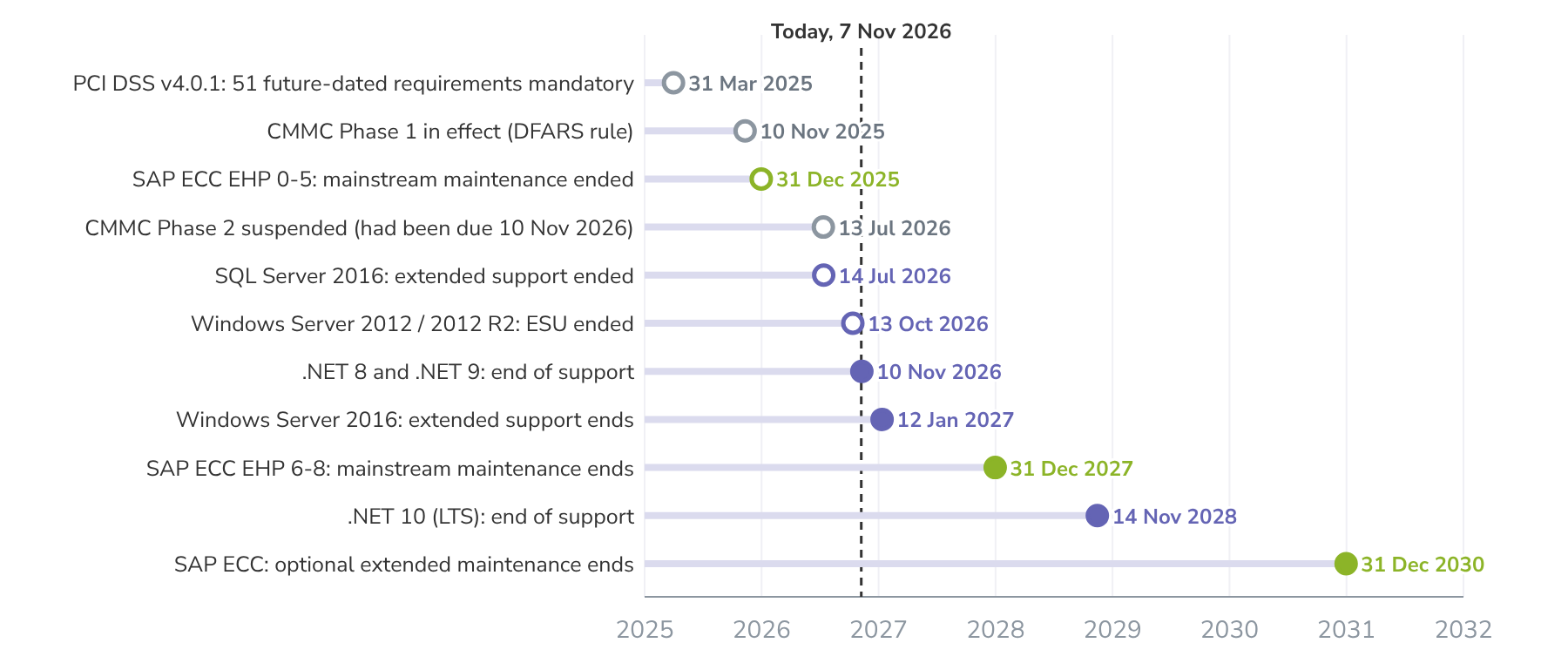
End-of-support dates are no longer abstract. .NET 8 and 9 lose support on 10 November 2026[1]. SQL Server 2016 already has[2]. Windows Server 2016 follows on 12 January 2027[3], and SAP ECC mainstream maintenance ends on 31 December 2027[4].
Attackers have noticed. Exploiting a vulnerability was the most common way into an organization in Verizon’s 2026 breach report, at 31% of breaches[5], and the average US breach now costs $11.5 million[6] [7]. Meanwhile the people who understand these systems are leaving: 69% of IBM i users name skills a top concern[8].
Why PE feels it first
A PE-owned company has the same problems on a clock, with a buyer waiting at the end. Holds are longer: 52% of global buyout inventory has been held for four years or more[9]. Value has to come from operations and add-ons[10], and add-ons were 72.9% of US buyouts in 2025[11]. Each one brings its own ERP, its own customer codes and its own definition of revenue.
Leaders change too. 65% of PE firms replace portfolio-company CEOs during the hold[12], and the CFO is the role hired most often[13]. A new CFO who cannot get a straight answer to “how do we calculate margin” loses months.
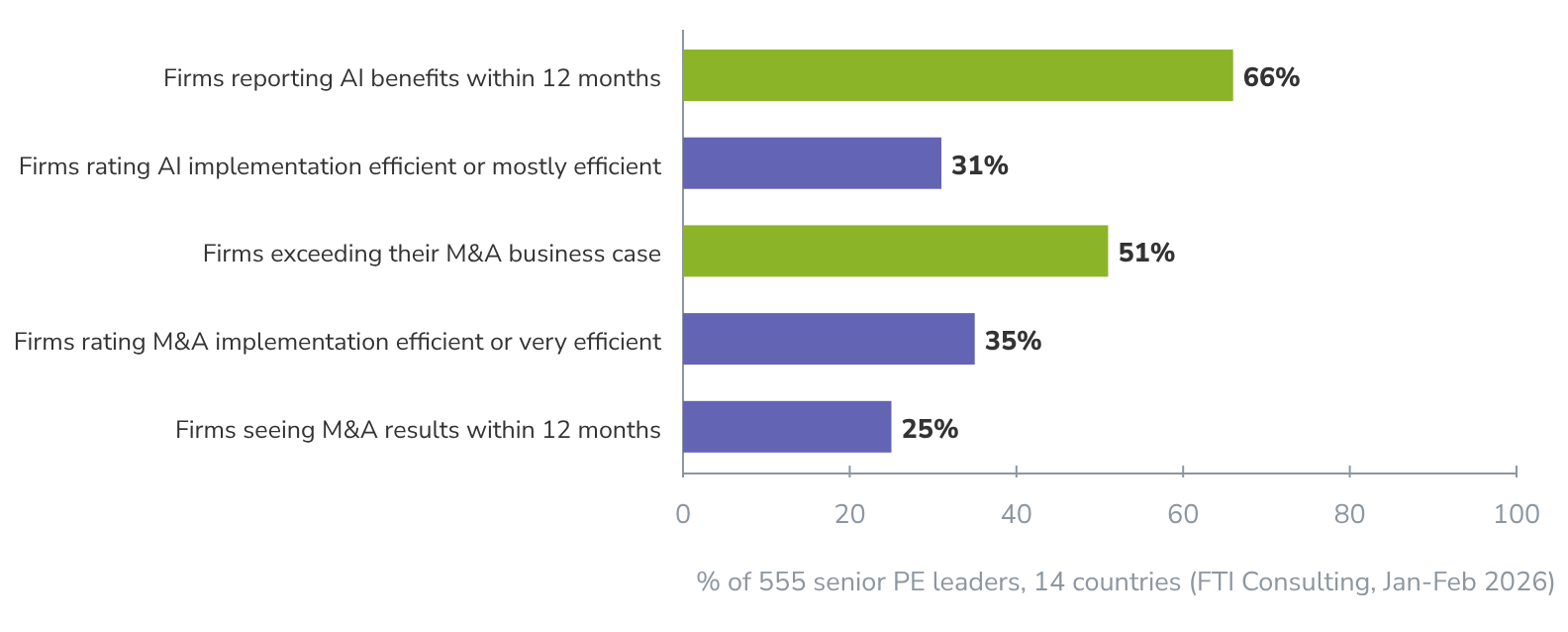
FTI’s 2026 survey puts numbers on the strain. Most firms see AI benefits within a year, yet only 31% call their AI implementation efficient. M&A is now the top value lever, and only 35% say they implement it efficiently[14].
AI helps with the typing, not the meaning
The best published AI migrations are genuinely impressive. Salesforce moved 275 Apex classes to Java in four months against an estimated two years[15]. Google reports that about 87% of AI-generated code in one migration was committed unchanged[16]. Look closely and they share a pattern: the model did the typing, and dependency graphs, tests and human review supplied the structure and the checking.
Take those away and the picture changes. In the AlphaTrans study, translated Java-to-Python code was syntactically valid 96% of the time, but functional correctness could be established for only 25% of the code that tests could reach[17]. Gartner expects more than 70% of mainframe exit projects started in 2026 to miss their intended benefits because buyers overestimate generative AI[18].
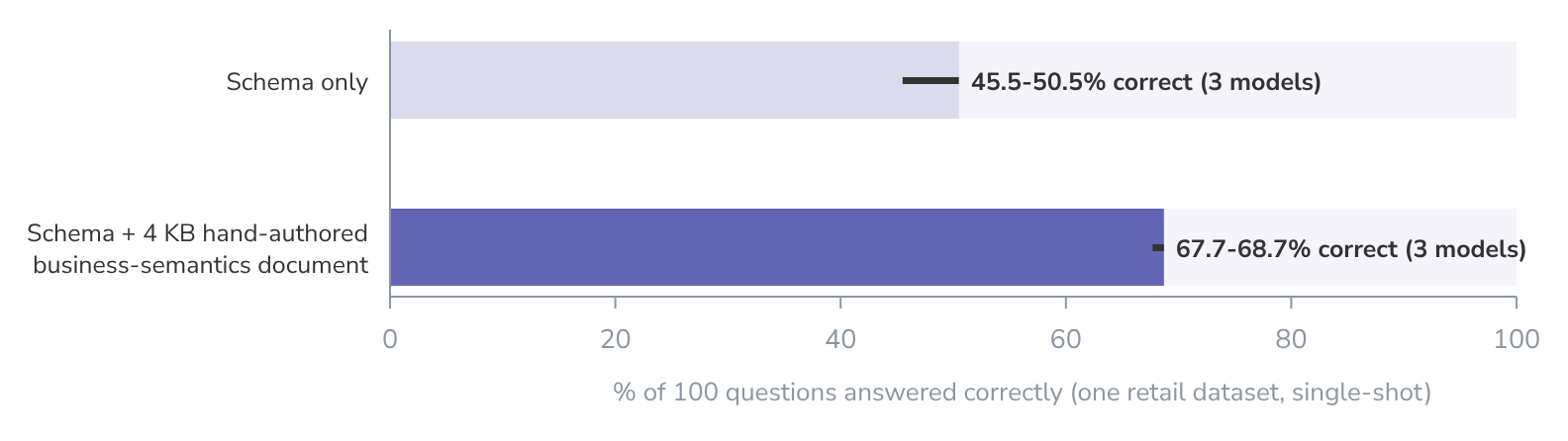
The most useful finding for anyone planning a modernization comes from a 2026 benchmark. Giving three frontier models a 4 KB description of the business’s measures and conventions raised their accuracy by 17 to 23 points. Choosing between those top models made no significant difference[19]. Context mattered more than the model. It was also not enough on its own.
“AI makes translation cheaper. It does not make meaning cheaper.”
Why “let the agents rebuild the process” fails
The popular pitch is to describe the business process, point agents at the legacy code and let them rebuild it on a modern platform. It struggles for reasons that have little to do with how capable the agents are.
Process maps describe what people believe happens. Legacy systems record what actually happens, including twenty years of exceptions. Code records decisions, not the reasons for them. In 2012 Knight Capital lost more than $460 million in 45 minutes after new code missed one server and orders for a new program triggered old, discontinued logic[20]. A model reading that code would have seen a flag. The decision behind it was written down nowhere the code could show.
What the code shows, and what the business means (illustrative)
| In the code | What the business means | Where that meaning lives |
|---|---|---|
order_type = 'Z9' |
National-account pricing that skips the standard price list | An email thread from 2019 |
status = 61 |
Automatic credit hold at 61 days past due | A stored procedure and one collector’s memory |
margin |
Finance: net of rebates and freight. Sales: gross | Three reports and a board-pack footnote |
Agents optimize for what they can check: the code compiles, the tests pass. If the tests encode last year’s definition of margin, the agent reproduces last year’s definition. Gartner already expects more than 40% of agentic AI projects to be cancelled by the end of 2027 over costs, unclear value and weak risk controls[21].
The missing piece: context as a product
Most AI modernization tools treat business context as a prompt, pasted in at the start of a session by whoever is in the room. In a revenue system it has to be treated as a product, with a named owner, a version history and evidence for every entry. Answers should cite the definition they used, or say they do not know.
That is what a context harness provides: an owner-approved, versioned layer of business context that every AI tool, migration team and new leader reads from the same place. The NStarX Context Harness connects to the sources where meaning lives, drafts definitions and rules with their evidence, has a named owner approve them, flags them for re-approval when sources change, and serves them to AI tools through a single MCP endpoint, within each caller’s permissions.
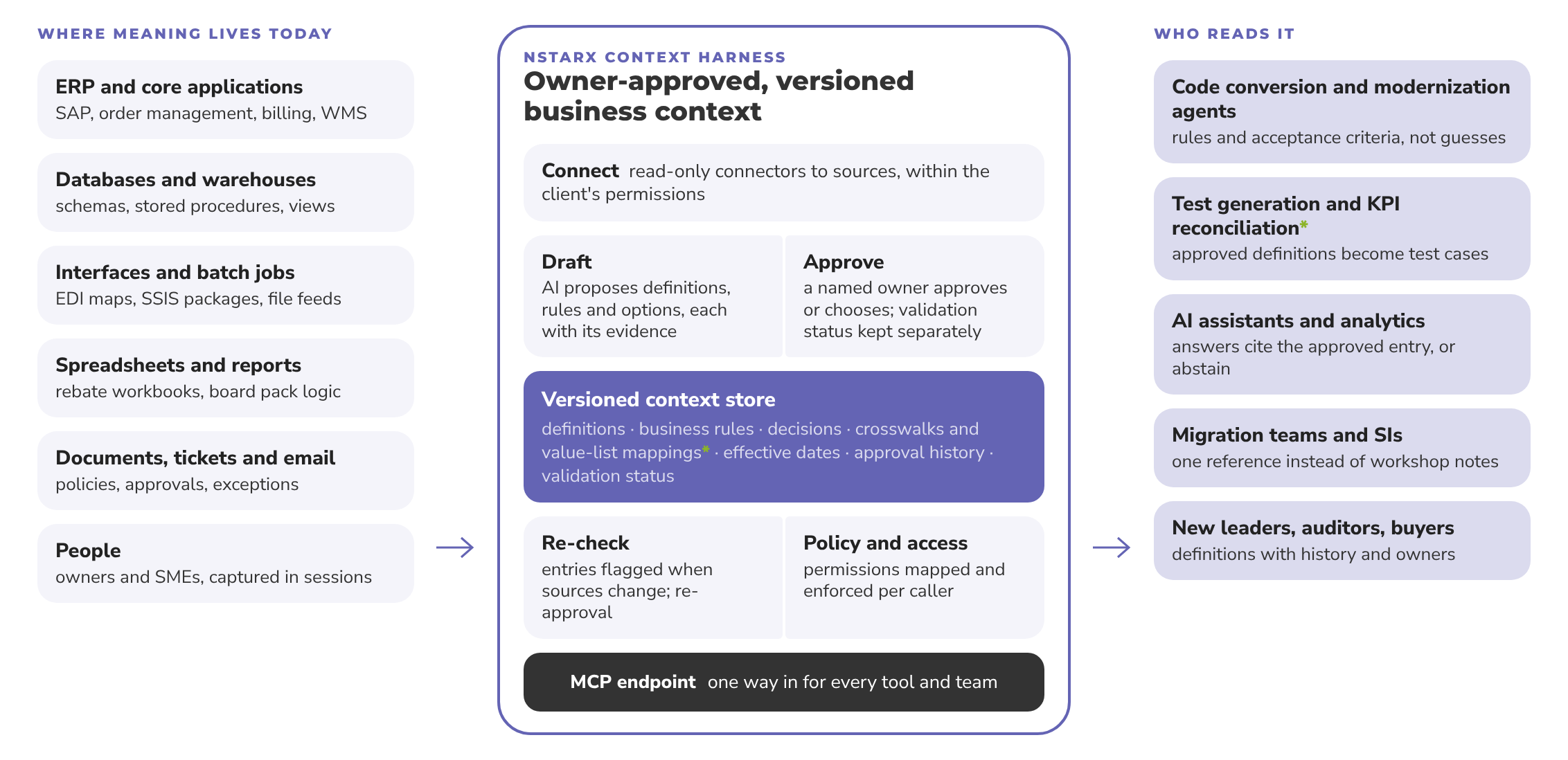
One distinction matters. Approval records who is accountable for a definition; it does not prove the definition is right. Each entry carries its validation status separately, so people and agents can see both.
Map the meaning before the agents arrive
The order of work is the point. Context capture belongs in Phase 0, before requirements and mapping design, not in the middle of cutover rehearsal when rules surface as defects.
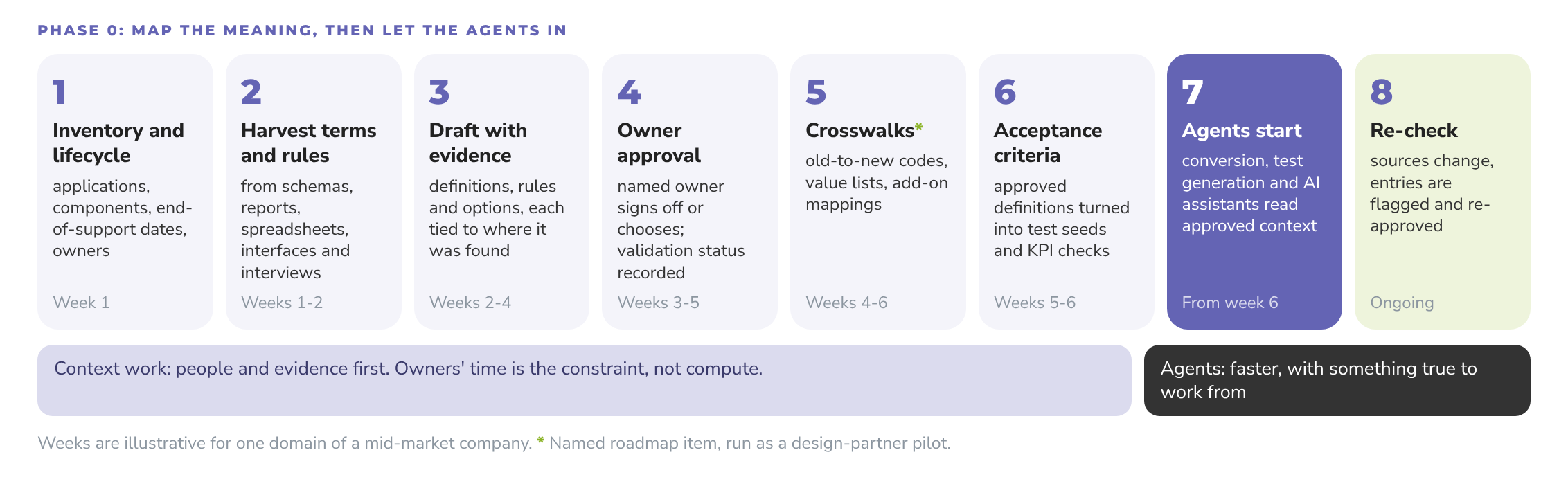
The signals that call for context show up early in an assessment:
- A key expert leaves within 18 months: capture what they know now.
- A migration needs old-to-new mappings: agree the rules before mapping design.
- An add-on is being integrated: settle definitions before integration design is signed off.
- AI tools are going onto legacy data: approve the definitions before the pilot goes live.
What it won’t fix
A context harness moves the hard part to where it can be managed. It does not make it disappear.
- Owners’ time is the real constraint. The people who can approve definitions are the busiest in the company.
- Tacit knowledge that is written down nowhere still needs interviews and walk-throughs.
- Security and data handling need a clear account of what is stored, logged and sent, with permissions enforced per caller[22].
- Migration assurance needs more than matching KPIs: record-level, transaction and behavioural tests, and often a parallel run[23].
How to know it is working
Context work earns its place only if it moves numbers that operating partners and portfolio leaders already track. Measure each one against a baseline in a pilot before it goes into a value creation plan:
- Hours spent reconciling numbers at month-end close.
- Days from an add-on closing to the first consolidated reporting pack.
- Mapping and rule defects found before the first cutover rehearsal, rather than after.
- Accuracy, coverage and citation quality of AI answers on an agreed set of business questions.
Where this goes
Code conversion will keep getting cheaper. As it does, the scarce input becomes meaning that someone can vouch for. We expect buyers to start asking for definitions, owners and approval history in diligence, the way they ask for a quality-of-earnings report today.
For operating partners, the next step is modest. In the next assessment at a portfolio company, add a Phase 0 for business context on the two or three systems closest to revenue. Measure the results against a baseline. Then decide, on evidence, whether to repeat it across the portfolio.
Sources
- .NET 8 and .NET 9 will reach End of Support on November 10, 2026. Microsoft .NET Blog, 29 June 2026. https://devblogs.microsoft.com/dotnet/dotnet-8-9-end-of-support/
- Extended Security Updates for SQL Server and Windows Server. Microsoft. https://www.microsoft.com/en-us/cloud-platform/extended-security-updates
- Windows Server 2016 End of Life: January 12, 2027, ESU and Upgrades. endoflife.ai, 18 September 2026 (dates from the Microsoft lifecycle). https://endoflife.ai/article-windows-server-2016-eol
- A Job Readiness Plan for SAP ECC End of Mainstream Maintenance 2027. BMC Software. https://www.bmc.com/blogs/sap-ecc-2027-job-scheduling-readiness/
- Vulnerability exploitation top breach entry point, 2026 industry-wide DBIR finds. Verizon, 19 May 2026. https://www.verizon.com/about/news/breach%2Dindustry%2Dwide%2Ddbir%2Dfinds
- Cost of a Data Breach Report 2026. IBM and Ponemon Institute. https://www.ibm.com/reports/data-breach
- Average cost of data breaches is up 12% this year: IBM. CFO.com, 2026. https://www.cfo.com/news/average-cost-of-data-breaches-is-up-12-this-year-IBM/827713/
- IBM i Skills Supplant Cybersecurity as the Community’s Top Concern: Fortra Survey. TechChannel, 2026. https://techchannel.com/skills-gap/fortra-survey-2026/
- McKinsey Global Private Markets Report 2026 (as reported). WealthBriefing Asia, 2026. https://www.wealthbriefingasia.com/printarticle.php?id=206921
- Private equity resurgence gathers steam as new era challenges firms to enhance value creation. Bain & Company, 23 February 2026. https://www.bain.com/about-bain/media-center/press-releases/2026/private-equity-resurgence-gathers-steam-as-new-era-challenges-firms-to-enhance-value-creationbain–company-global-pe-report/
- The Sponsor Exit: 2026 Report (citing PitchBook US PE Breakdowns). Windsor Drake, 2026. https://windsordrake.com/market-intelligence/reports/the-sponsor-exit-2026-report
- Nearly Two-thirds of Private Equity Firms Replace Portfolio Company CEOs During the Holding Period. AlixPartners via Mondaq, 30 March 2026. https://www.mondaq.com/pressrelease/192246/nearly-two-thirds-of-private-equity-firms-replace-portfolio-company-ceos-during-the-holding-period-alixpartners-survey-finds
- Extended Holding Periods Put Leadership Talent at the Center of Private Equity Performance. Altrata, 26 February 2026. https://altrata.com/news/extended-holding-periods-put-leadership-talent-at-the-center-of-private-equity-performance
- AI Speeds Up Returns in Private Equity as M&A Becomes Top Value Generator for Firms. FTI Consulting via GlobeNewswire, 4 June 2026. https://www.globenewswire.com/news-release/2026/06/04/3306571/33891/en/AI-Speeds-Up-Returns-in-Private-Equity-as-M-A-Becomes-Top-Value-Generator-for-Firms.html
- How AI-Driven Refactoring Cut a 2-Year Legacy Code Migration to 4 Months. Salesforce Engineering. https://engineering.salesforce.com/?p=7945
- How is Google using AI for internal code migrations?. Nikolov et al., Google (arXiv 2501.06972). https://arxiv.org/html/2501.06972v1
- AlphaTrans: A Neuro-Symbolic Compositional Approach for Repository-Level Code Translation and Validation. Ibrahimzada et al., arXiv 2410.24117v5, June 2025. https://arxiv.org/html/2410.24117v5
- Gartner Predicts More Than 70% of Mainframe Exit Projects Will Fail Due to Overestimation of Generative AI’s Capabilities. Gartner, 18 June 2026. https://www.gartner.com/en/newsroom/press-releases/2026-06-18-gartner-predicts-more-than-70-percent-of-mainframe-exit-projects-will-fail-due-to-overestimation-of-generative-ais-capabilities
- Semantic Layers for Reliable LLM-Powered Data Analytics: A Paired Benchmark of Accuracy and Hallucination Across Three Frontier Models. Rumiantsau and Fokeev, arXiv 2604.25149, April 2026. https://arxiv.org/abs/2604.25149
- SEC Charges Knight Capital With Violations of Market Access Rule (Press Release 2013-222). U.S. Securities and Exchange Commission, 16 October 2013. https://www.sec.gov/news/press-release/2013-222
- Gartner Predicts Over 40% of Agentic AI Projects Will Be Canceled by End of 2027. Gartner, 25 June 2025. https://www.gartner.com/en/newsroom/press-releases/2025-06-25-gartner-predicts-over-40-percent-of-agentic-ai-projects-will-be-canceled-by-end-of-2027
- Model Context Protocol: Security Best Practices. modelcontextprotocol.io. https://modelcontextprotocol.io/specification/latest/basic/security_best_practices
- Parallel run with reconciliation. Thoughtworks Technology Radar. https://thoughtworks.com/radar/techniques/parallel-run-with-reconciliation
Download Whitepaper
The Meaning Is the Asset
Legacy modernization in private-equity portfolios: why AI agents alone will not carry it, and the business context that has to come first
The Meaning Is the Asset covers the evidence in detail, the current solutions and their limits, the reference architecture, the problems a context harness does not remove, and a full metrics map for portfolio leaders and operating partners.