




The Modernization Mandate: Why AI Readiness Changes Everything About How Enterprises Transform
A strategic guide for CIOs, CTOs, and enterprise leaders navigating the choice between transformational overhauls and incremental modernization in an AI-first world.
Discover why AI readiness has fundamentally changed the enterprise modernization calculus — and how to sequence your transformation to unlock AI value at every step, not just at the finish line.
Most enterprise AI programs aren’t failing because the models are wrong. They’re failing because the systems underneath them were never designed to support them. Here’s what the data says — and what to do about it.
Every enterprise technology leader is under pressure to deploy AI. The board wants it. The CEO has announced it. The competitors are doing it. And yet, across industry after industry, ambitious AI programs are stalling — not at the model layer, but at the infrastructure layer.
Fewer than one in five mid-market enterprises have a data architecture capable of supporting production-grade AI workloads without significant remediation. The gap is not technical sophistication — it is the accumulated weight of deferred architectural decisions, fragmented data ownership, and governance frameworks designed for compliance audits, not AI reliability.
Modernization is no longer an IT initiative. It is the prerequisite infrastructure for enterprise AI.
This post draws from our new white paper, The Modernization Mandate, which examines the strategic choice that now sits at the center of every enterprise technology agenda: how you modernize matters more than whether you modernize — and the sequencing decisions you make in the next 12 months will determine your AI competitiveness for the next five years.
What AI Actually Needs From Your Infrastructure
When engineering teams move beyond sandbox experiments into production deployment, a consistent set of blockers surfaces. The models aren’t the problem. Here is what they actually require — and what most legacy environments deliver instead:
| What AI Needs | What Legacy Delivers | Gap Severity |
|---|---|---|
| Clean, labeled data at inference speed | Batch exports, siloed formats, inconsistent labeling | Critical |
| Data lineage & governance for model provenance | Compliance-only governance, no ML traceability | Critical |
| API-first architecture for real-time read/write | Batch integrations, undocumented endpoints | Critical |
| Observability for model drift & output quality | Uptime monitoring only, no ML-aware tooling | High |
| Zero Trust security for elevated AI agent access | Perimeter-based models, incomplete identity controls | High |
Legacy systems don’t just slow AI down. They corrupt it — quietly, at scale, and often without anyone noticing until the damage is done. When an AI agent built on a fragmented data model processes ten thousand customer interactions a day, it doesn’t repeat one data quality error. It produces ten thousand variations of it, at speed.
The Big Bang Trap — and Why It’s Worse in an AI World
The appeal of wholesale transformation is visceral: one decision, one program, one cutover, and you emerge on the other side with a clean architecture. The data on whether this narrative holds up is unambiguous — and it has gotten worse, not better, in an era where AI requires continuous infrastructure investment rather than a single modernization event.
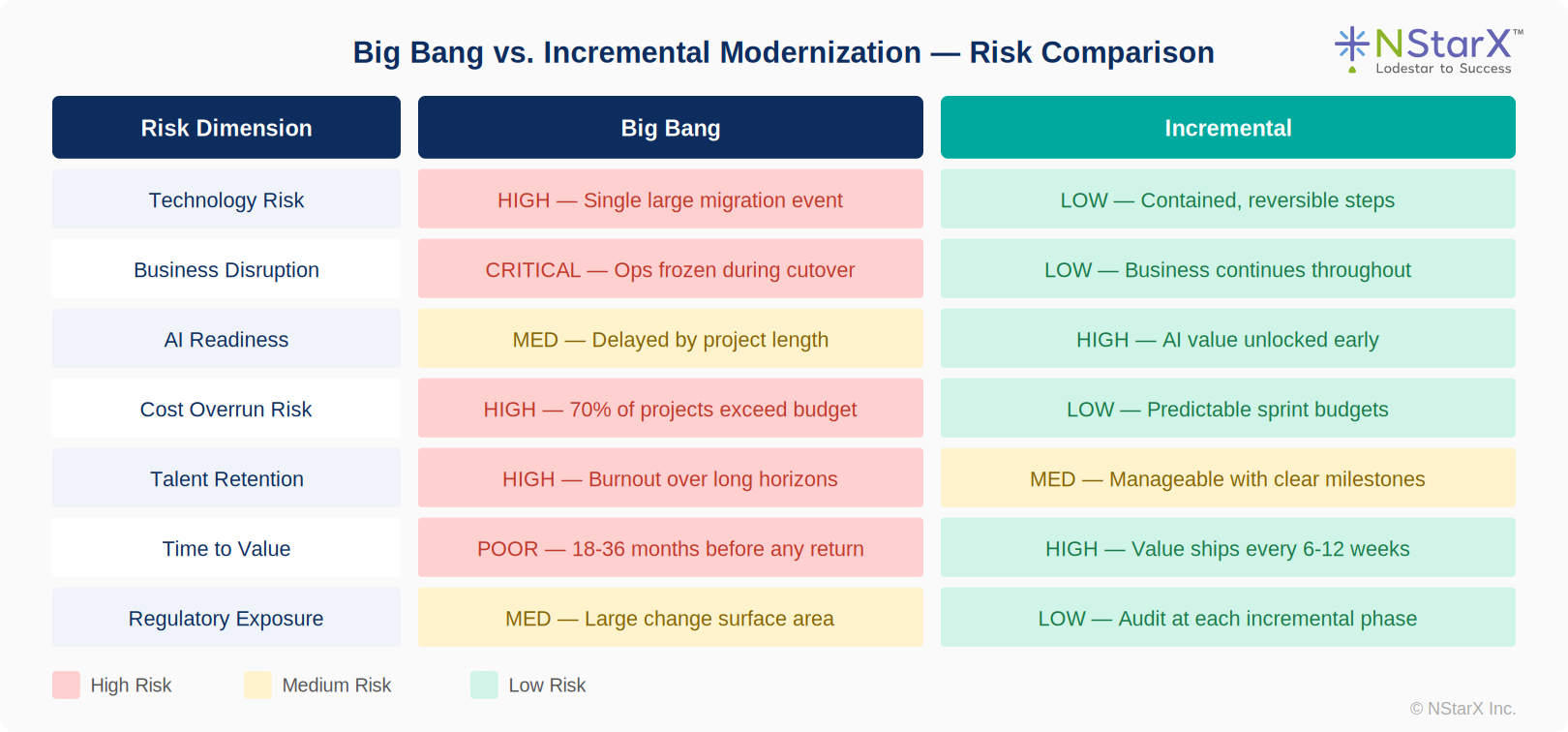
Figure 1: Risk Profile Comparison — Big Bang vs. Incremental Modernization (scored 1–5 where 5 = highest risk)
| Risk Dimension | Big Bang | Incremental |
|---|---|---|
| Technology Risk | HIGH — Single large migration event | LOW — Contained, reversible steps |
| Business Disruption | CRITICAL — Ops frozen during cutover | LOW — Business continues throughout |
| AI Readiness | MED — Delayed by project length | HIGH — AI value unlocked early |
| Cost Overrun Risk | HIGH — 70% of projects exceed budget | LOW — Predictable sprint budgets |
| Talent Retention | HIGH — Burnout over long horizons | MED — Manageable with clear milestones |
| Time to Value | POOR — 18-36 months before any return | HIGH — Value ships every 6-12 weeks |
| Regulatory Exposure | MED — Large change surface area | LOW — Audit at each incremental phase |
The organizations that modernize successfully share a common characteristic: they have stopped debating the philosophical question of big bang vs. incremental and started asking a more practical one — which modernization investments unlock AI value first?
Key Finding
Big bang transformations delivered first measurable AI business value at an average of 22 months post-initiation. Incrementally modernized organizations with an AI-unlock-first sequencing strategy delivered measurable AI value at an average of 6 months.
The Cost of Waiting Is Compounding — Quarterly
The financial case for modernization is frequently modeled as a one-sided investment: what does it cost to modernize, and when do you break even? That framing misses the more important number — what does it cost to stay where you are, and how does that cost grow over time?
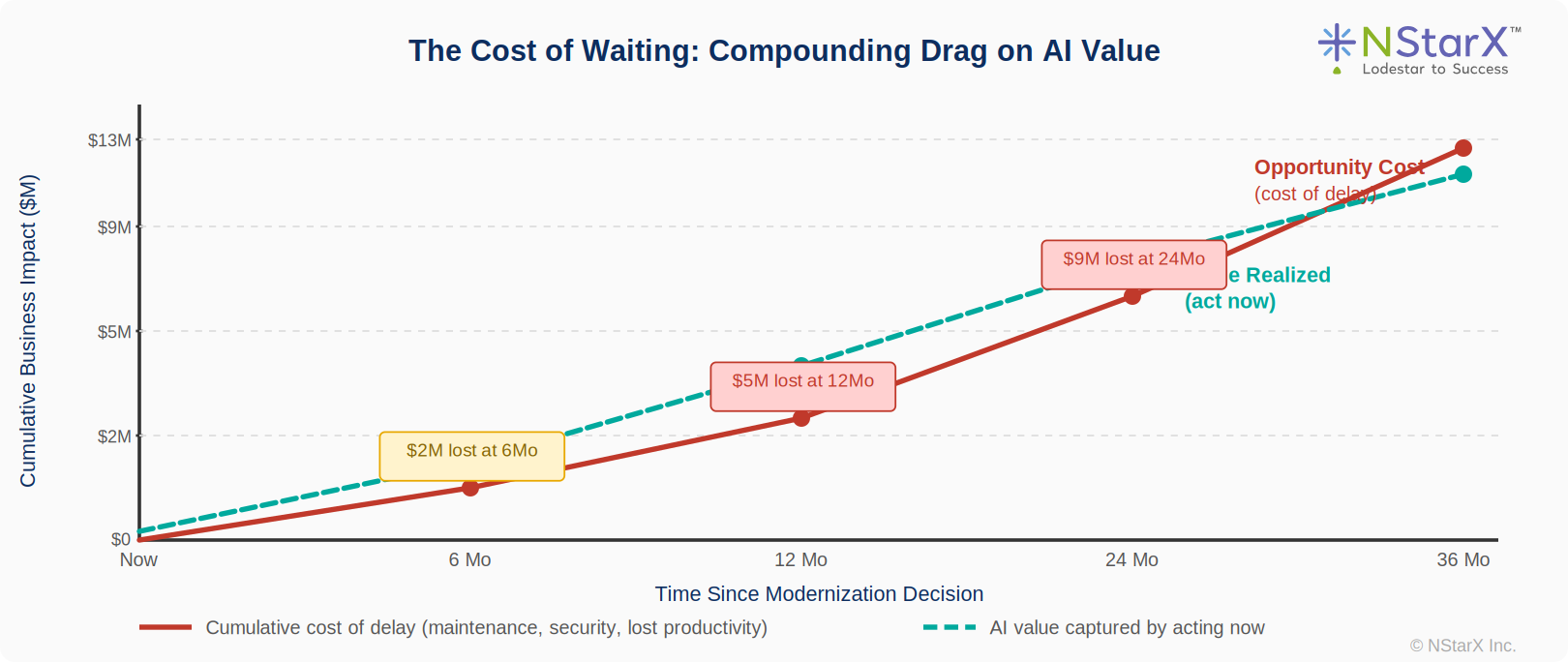
Figure 2: Compounding Cost of Modernization Delay — maintenance, security, talent attrition, and lost AI productivity ($M)
| Time Since Modernization Decision | Cumulative Cost of Delay |
|---|---|
| 6 months | $2M lost |
| 12 months | $5M lost |
| 24 months | $9M lost |
| 36 months | ~$13M lost |
Maintenance costs alone — the fully-loaded cost of keeping legacy systems operational, including specialist talent, incident response, manual workarounds, and engineering opportunity cost — typically run three to five times the cost of operating a modern equivalent. The competitive gap compounds on top of that. The organizations winning with AI right now are those with the cleanest data, the strongest governance, and the most modular architectures — built through exactly the kind of incremental, AI-unlock-first modernization that most enterprises are still debating rather than executing.
Where Your Industry Actually Stands
AI readiness is not a binary state. It is a six-dimensional profile that varies significantly across industries. The heatmap below captures the current state across the five sectors assessed in depth for the white paper.
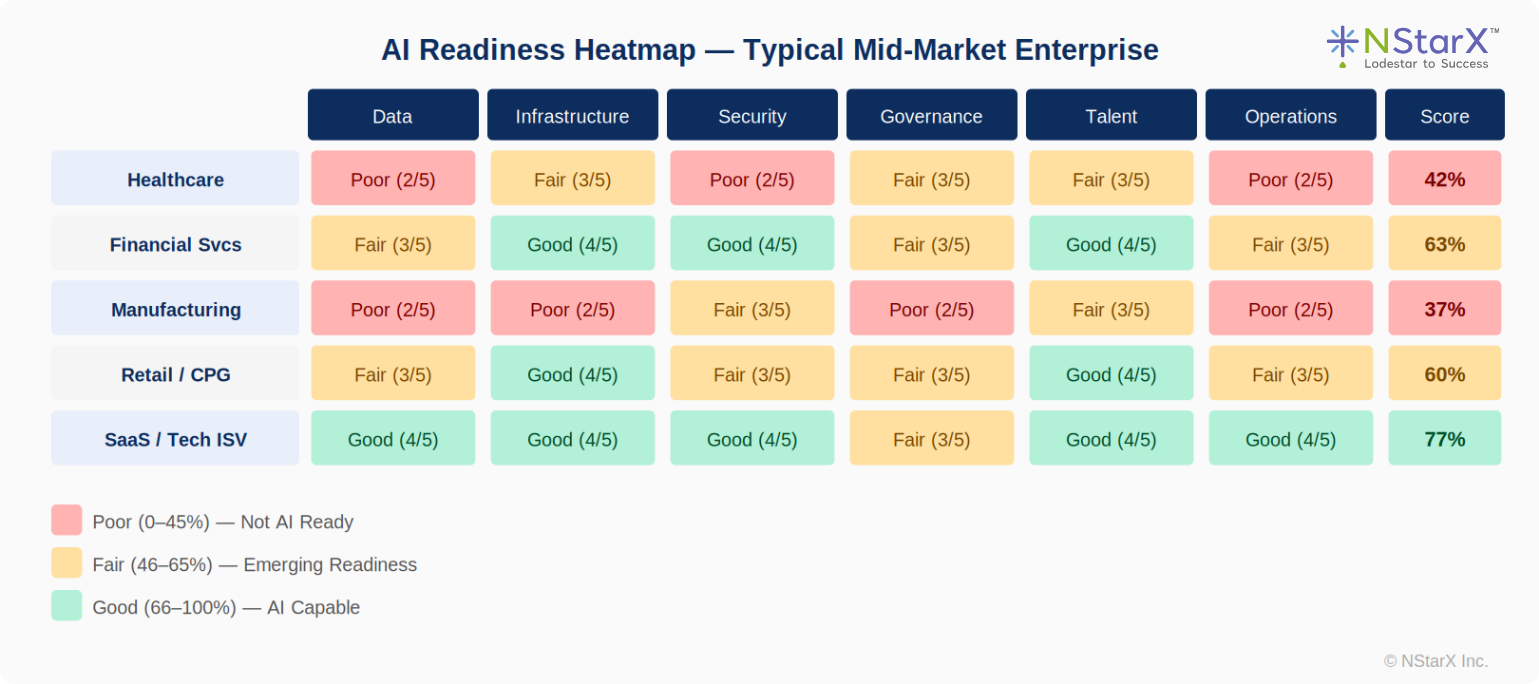
Figure 3: AI Readiness Heatmap by Industry — six dimensions scored 1–5 (Red = not ready, Amber = emerging, Green = capable)
| Industry | Data | Infrastructure | Security | Governance | Talent | Operations | Score |
|---|---|---|---|---|---|---|---|
| Healthcare | Poor (2/5) | Fair (3/5) | Poor (2/5) | Fair (3/5) | Fair (3/5) | Poor (2/5) | 42% |
| Financial Svcs | Fair (3/5) | Good (4/5) | Good (4/5) | Fair (3/5) | Good (4/5) | Fair (3/5) | 63% |
| Manufacturing | Poor (2/5) | Poor (2/5) | Fair (3/5) | Poor (2/5) | Fair (3/5) | Poor (2/5) | 37% |
| Retail / CPG | Fair (3/5) | Good (4/5) | Fair (3/5) | Fair (3/5) | Good (4/5) | Fair (3/5) | 60% |
| SaaS / Tech ISV | Good (4/5) | Good (4/5) | Good (4/5) | Fair (3/5) | Good (4/5) | Good (4/5) | 77% |
The pattern is consistent: technology companies and well-capitalized financial services firms have invested in the foundational layers. Healthcare and manufacturing lag significantly — particularly in data quality and governance, the two dimensions that are absolute prerequisites for responsible AI deployment in their regulatory environments.
The Five Levels — Where Most Organizations Actually Are
Our AI Readiness Maturity Model maps five organizational states. The honest assessment for most mid-market enterprises: Level 1 or Level 2.
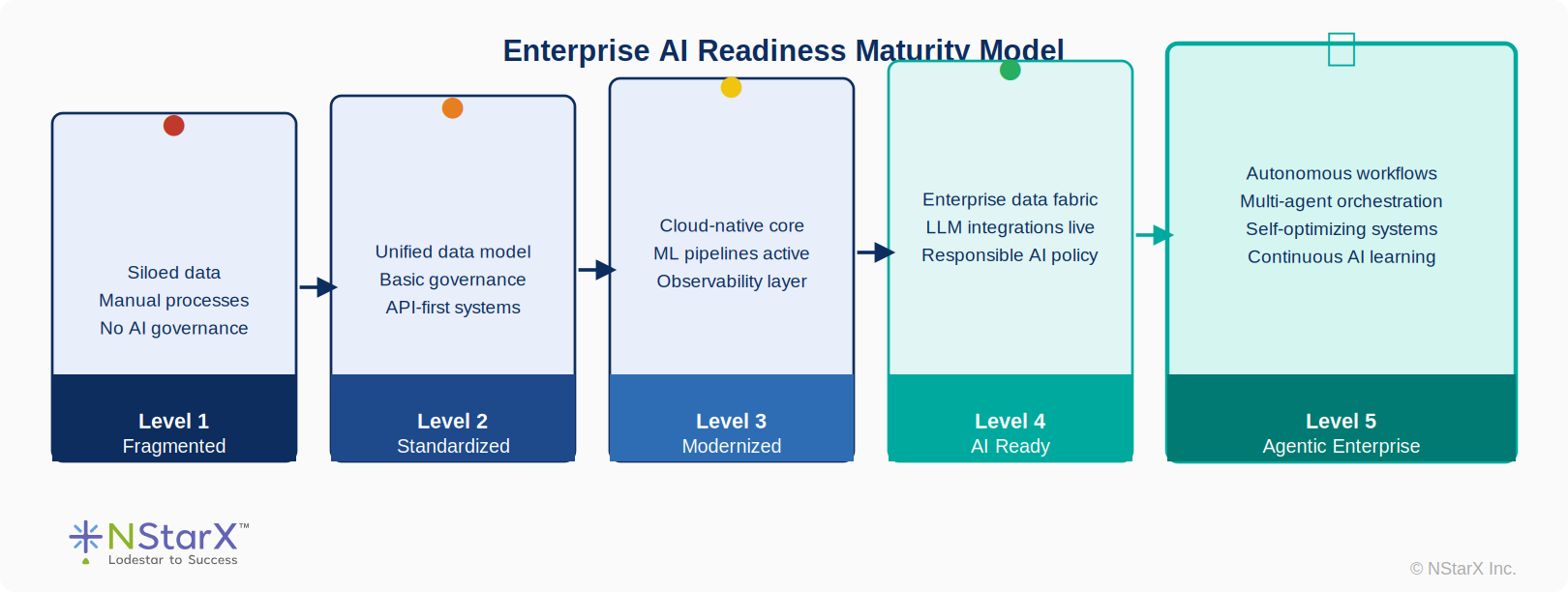
Figure 4: Enterprise AI Readiness Maturity Model — Levels 4–5 represent the competitive target for 2025–2027
Level 1: Fragmented
Data is siloed. Processes are manual. There is no governance framework for AI, and data quality issues are severe enough that even basic analytics are unreliable. Organizations at this level cannot deploy production AI safely.
Level 2: Standardized
The organization has made progress on data unification — a common data model, basic governance, and API exposure for key systems. This is where most organizations are beginning AI experiments, with limited success, because the foundation supports analytics but not the real-time access and governance depth that production AI requires.
Level 3: Modernized
Cloud-native infrastructure. Active ML pipelines. Observability in place. Organizations at Level 3 can begin deploying AI in well-scoped, lower-risk use cases. This is the transition point where incremental investments start to generate compound returns.
Level 4: AI Ready
An enterprise data fabric is in place. Large language models are integrated into business workflows. Responsible AI policies govern model deployment. Organizations at this level are deploying AI in production across multiple business functions.
Level 5: Agentic Enterprise
AI agents coordinate across business systems, handle decisions autonomously within defined parameters, and continuously improve through feedback loops. Human oversight is embedded in the architecture — applied at the right level of abstraction, not consumed by routine decisions.
The path from Level 1 to Level 4 is a sequence of bounded, high-value investments — each unlocking new AI capabilities and generating the confidence and financial return to fund the next step. The white paper details the specific investment sequence, including where organizations consistently underinvest (governance) and where they over-invest prematurely (AI tooling before the data foundation is ready).
Experimentation First. Production-Grade Fast.
The framework that has gained the most traction among organizations moving quickly on AI readiness is the structured rapid-validation model: a defined-scope Proof of Value engagement — typically six weeks — designed to validate a specific business hypothesis against real data, followed by a 12-week Minimum Viable Product sprint to production deployment.
Most enterprises don’t need more AI ideas. They need a safer way to test them.
This framework changes the executive conversation. Rather than asking a board to approve a multi-year modernization program, it asks for approval of a six-week investment with a defined decision gate. If the POV validates — if it demonstrates against real data that the AI use case works — the case for the next phase is almost self-evident. If it doesn’t, the organization has learned something valuable at a fraction of the cost of discovering the same thing two years into a full transformation.
The organizations that will lead in AI over the next three years are not those that make the boldest AI announcements today. They are those that build the most disciplined infrastructure for continuous AI deployment — starting with clean data, strong governance, and a willingness to validate before they scale.
Download Whitepaper
The Modernization Mandate: Why AI Readiness Changes Everything About How Enterprises Transform
A strategic guide for CIOs, CTOs, and enterprise leaders navigating the choice between transformational overhauls and incremental modernization in an AI-first world.
Discover why AI readiness has fundamentally changed the enterprise modernization calculus — and how to sequence your transformation to unlock AI value at every step, not just at the finish line.